A Trial is Where the Risk Lives
Trial risks are actually greater than a proved operation - and decisions need to reflect this.
Scott Dunham
6/23/20268 min read
The Glan Devon Bio-Fertiliser Project is being promoted as a better way to manage biosolids and support agriculture. On the project website it is described as a “first-of-a-kind project in Australia” that will convert biosolids into a dry, pelletised fertiliser ready for use on local farms.
That sounds positive, and it is meant to sound positive. First-of-a-kind projects can be exciting. They can also be useful. Every mature industry started somewhere, and innovation should not be rejected simply because it is new.
But the phrase “first-of-a-kind” matters. It tells us that this is not a routine, long-established, locally proven industrial process with a long Australian operating history. It tells us the project is somewhere on the journey between concept, demonstration, trial and robust commercial operation. That does not make it bad, but it does change the questions that should be asked before a rural community is expected to live beside it.
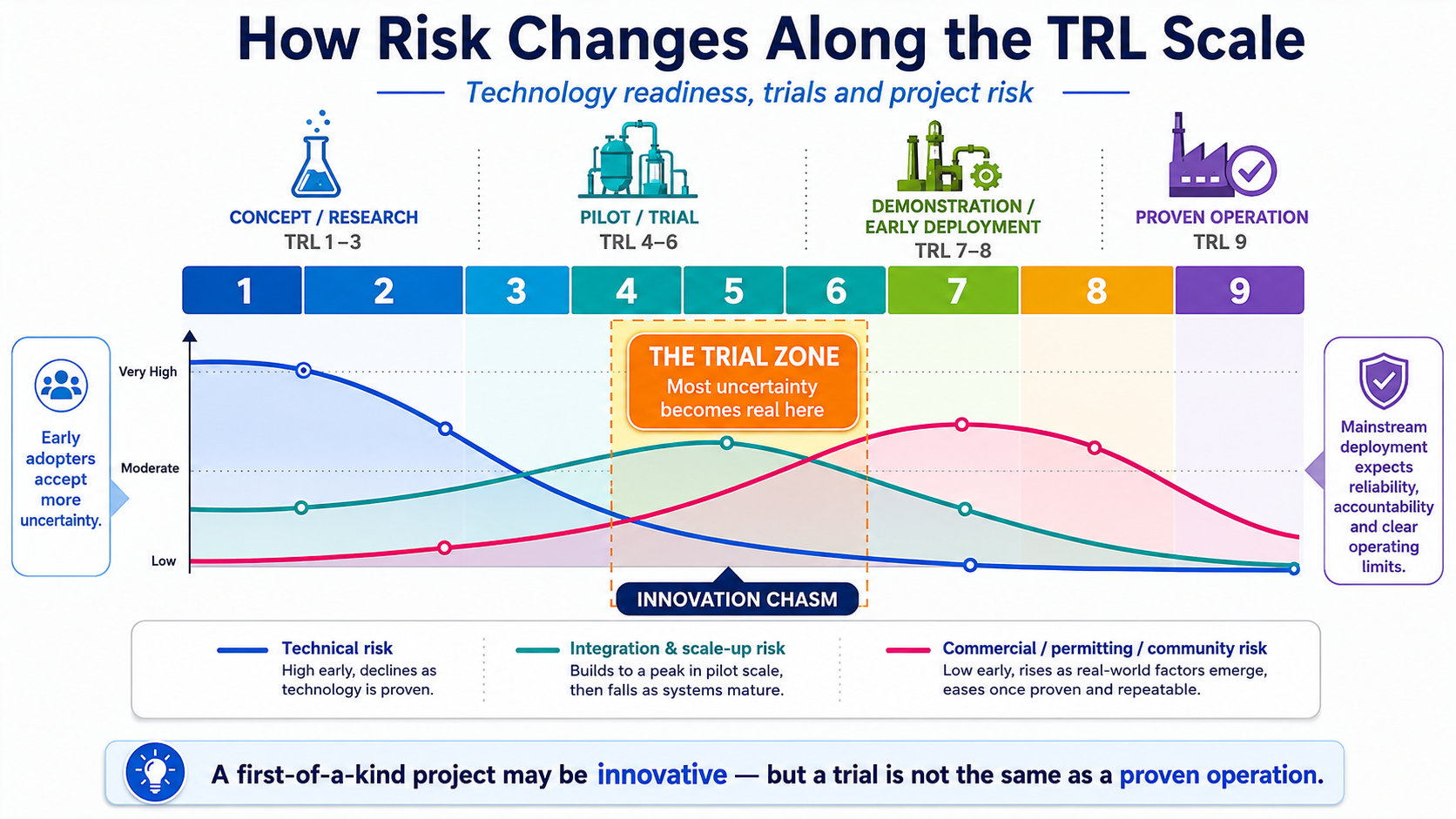
In technology and industrial development, people often talk about Technology Readiness Levels, or TRLs. TRL's were first developed by NASA as a way to help understand risk. The idea is simple enough. A technology starts as a concept, then moves through lab testing, pilot testing, demonstration, commercial trial and finally proven operation. The higher the TRL, the more confidence there should be that the system will work under real conditions, not just in a controlled test or a carefully managed demonstration.
The important point is that a technology can be real without being mature. It can exist. It can work. It can have a successful demonstration behind it. It can even be commercially manufactured in some form. But that does not automatically mean the whole proposed system has been proven at the proposed site, with the proposed inputs, proposed scale, proposed operating conditions, proposed environmental controls, proposed markets and proposed regulatory pathway.
That is where many innovation projects run into trouble. The difficult step is not always proving that a machine can run. The difficult step is proving that the whole system can run reliably, safely, economically and repeatedly under normal operating pressure. A plant is not just a piece of equipment. It is feed supply, storage, handling, moisture variation, fuel variation, emissions control, odour control, residues, maintenance, staff, breakdowns, neighbours, regulators, trucks, product quality, customers and cash flow. Any one of those can become the constraint.
This is why industry is often conservative about new technology. It is not because industry lacks imagination. It is because industry has learned, often expensively, that technical promise and operational reliability are not the same thing.
A useful example comes from mining. For a period I was involved with CRC ORE, where one of the central ideas was “grade engineering.” The concept was attractive and, in many ways, technically sensible. Instead of treating all mined material as if it deserved the same expensive processing pathway, the idea was to reject waste as early as possible. If low-value material could be identified and removed before it reached the most energy-intensive parts of the plant, especially crushing and grinding, then the whole operation could become more efficient.
The building blocks for CRC ORE were not fantasy. Most of the technology existed in one way or another. Each part could be explained. Each part had examples. The broader idea was clever: stop thinking about the mine and plant as separate boxes, and start designing the whole system around early waste rejection.
Yet that is exactly where the difficulty appeared. The individual pieces were not the same as a mainstream, whole-of-operation revolution. Some techniques worked in some deposits. Some worked under some mining methods. Some worked at some scales. Some required orebody characteristics that were not always present. Some needed changes to planning, haulage, stockpiling, plant control, reconciliation and commercial decision-making. The more the idea moved from a technical concept into a real operating business solution, the more it had to deal with variation, constraints, risk appetite, capital allocation and the conservative reality of production. Does this sound familiar?
That does not mean the research was worthless. It does not mean the ideas were wrong. Some of the components are used in some cases, and some of the thinking remains useful. But it did not become the whole-of-system revolution some people hoped it would become. It remains more of a specialist toolset than a normal way the mining industry operates.
That is the lesson. Proving technical pieces is not the same as proving an integrated operating system. A process can be promising, rational and supported by real science, and still not cross the chasm into normal industry practice.
This is the point people often miss when they hear words like “trial”, “innovation” or “first-of-a-kind.” The hard question is not whether the idea has merit. The hard question is whether the whole system has been proven under the messy conditions of real operation, with real inputs, real operators, real maintenance, real economics, real regulators and real consequences for people around it.
That distinction is central to the Glan Devon proposal.
The question is not whether biosolids exist. They do. It is not whether drying technologies exist. They do. It is not whether thermal treatment technologies exist. They do. It is not whether fertiliser blending and pelletising exist. They do. The question is whether this particular integrated system has been proven as a whole, under conditions that are truly representative of what is proposed at Glan Devon.
That is a very different question.
If the project is a first-of-a-kind Australian project, what exactly is first-of-a-kind? Is it the use of waste-derived heat to dry biosolids? Is it the combination of biosolids, non-recyclable waste, treated timber, thermal conversion, fertiliser blending and pellet production? Is it the control system? Is it the product pathway? Is it the commercial model? Is it the regulatory pathway? Each of those possibilities carries a different type of risk, and each should be assessed honestly.
This is where the word “trial” becomes important. A trial is not proof. A trial is the process by which proof is sought. It exists because there are still questions to answer. Some of those questions are known in advance: Can the plant meet throughput? Can it handle variable biosolids? Can it handle variation in fuel inputs? Can it control odour? Can it meet emissions limits? Can residues be safely managed? Can the final product meet quality requirements? Will farmers buy and use it? Can the operation make money without stretching its operating envelope?
But trials also reveal unknown unknowns. Anyone who has worked around real industrial systems has seen that. Things change. The pump will not pump. The material bridges in the bin or shed. The dryer behaves differently when the feed moisture changes. The fuel value varies. The filter blinds. A residue stream becomes harder to handle than expected. Maintenance takes longer than planned. A process that works in batch mode becomes unstable in continuous operation. A system designed around average inputs struggles with short-term variation.
Average conditions can be misleading. Industry does not operate on averages alone. It operates on variation, interruptions, constraints and pressure. That is why trials matter, and it is why the design of the trial matters.
Whether it is legally treated as a formal trial or simply described in trial-like language, the practical issue is the same: what remains unproven, and who carries that risk?
There is another concept that helps explain this: the difference between early adopters and the mainstream. Early adopters are people or organisations that knowingly accept more uncertainty because they want to be first, or because they believe the potential reward is worth the risk. They tolerate rough edges. They expect learning. They accept variability as part of the price of being close to the bleeding edge.
That is a valid choice for someone investing their own money, on their own site, with their own risk appetite. It is not the same thing as asking a rural community to live beside the trial.
The community is not an early adopter in the commercial sense. The community is not choosing to invest in a technology venture. Local residents are not shareholders in the upside. They do not get a premium because the project is first-of-a-kind. They are not volunteering to accept odour, truck movements, emissions uncertainty, product failure, stockpile risk or future expansion pressure as the price of innovation. If the project works, the benefit may accrue to the proponent, to waste suppliers, to the circular economy story, and perhaps to some local employment or farm users. If the project does not work cleanly, the cost may be carried by neighbours, roads, Council, regulators and the wider district.
That is the imbalance Council and SARA need to recognise.
A trial mindset may be acceptable inside an innovation company. It may be acceptable inside a research program. It may be acceptable to a venture investor. It may even be acceptable to an industrial partner with the technical staff, capital and appetite to manage uncertainty. But a rural community should not be forced into the early-adopter risk mindset unless the trial is tightly defined, independently monitored and clearly bounded.
This does not mean the project should automatically be rejected. It means the approval, if there is one, must match the maturity of the project. If the project is genuinely a trial, then it should be assessed and conditioned as a trial. It should not be treated as a proven industrial activity that simply needs permission to begin.
A real trial should say exactly what is being tested. It should define the feedstock envelope, the fuel envelope, the operating limits, the monitoring regime, the product quality requirements, the residue management rules and the failure conditions. It should say how success will be measured and who will verify the results. It should say what happens if odour becomes a problem, if emissions exceed expectations, if the product cannot be sold, if waste streams are rejected, if residues accumulate, if the plant cannot operate continuously, or if the economics push the operator to seek more volume or different inputs.
Most importantly, a trial should have a hard boundary between Stage 1 and Stage 2. If Stage 1 is a trial, then Stage 2 should not be treated as an automatic scale-up. Scaling up is often where the chasm appears. A small or controlled operation may hide problems that only become obvious when volumes rise, when storage increases, when more trucks arrive, when feed variability grows, when maintenance is deferred, or when the business has to operate closer to capacity to pay its way.
That is the lesson from many industrial innovation projects. The chasm is not between “good idea” and “bad idea.” It is between a promising technical concept and a robust commercial system. The first can be demonstrated. The second has to be proven.
For Glan Devon, the reasonable public question is therefore quite narrow and quite practical: where is this project on the readiness ladder, and who carries the risk of the remaining uncertainty?
If the applicant can show comparable end-to-end operation elsewhere, with similar feedstocks, similar fuel inputs, similar emissions controls, similar product requirements, similar residues, similar scale and similar regulatory expectations, then that evidence should be put clearly on the table. If the project is first-of-a-kind in Australia because the integrated system has not been operated here before, then Council should require the discipline that normally comes with early-stage deployment: hard limits, independent verification, transparent reporting and no assumed right to expand.
Innovation deserves a pathway. But a pathway is not a blank cheque. A first-of-a-kind project may be a selling point for the proponent, but it is also a signal that the community is being asked to host something that has not yet become routine.
The community should not be asked to live in the early-adopter risk mindset. If this is a trial, then Council should treat it like a trial: define it, bound it, monitor it, test it, report it, and make any future expansion depend on evidence rather than optimism.
Join the conversation
© 2026. All rights reserved.