An unexpected event at the cattle yards
All models are wrong, some models are useful. Some models are dangerous. The trick is sorting out one from the other.
Scott Dunham
7/12/20266 min read
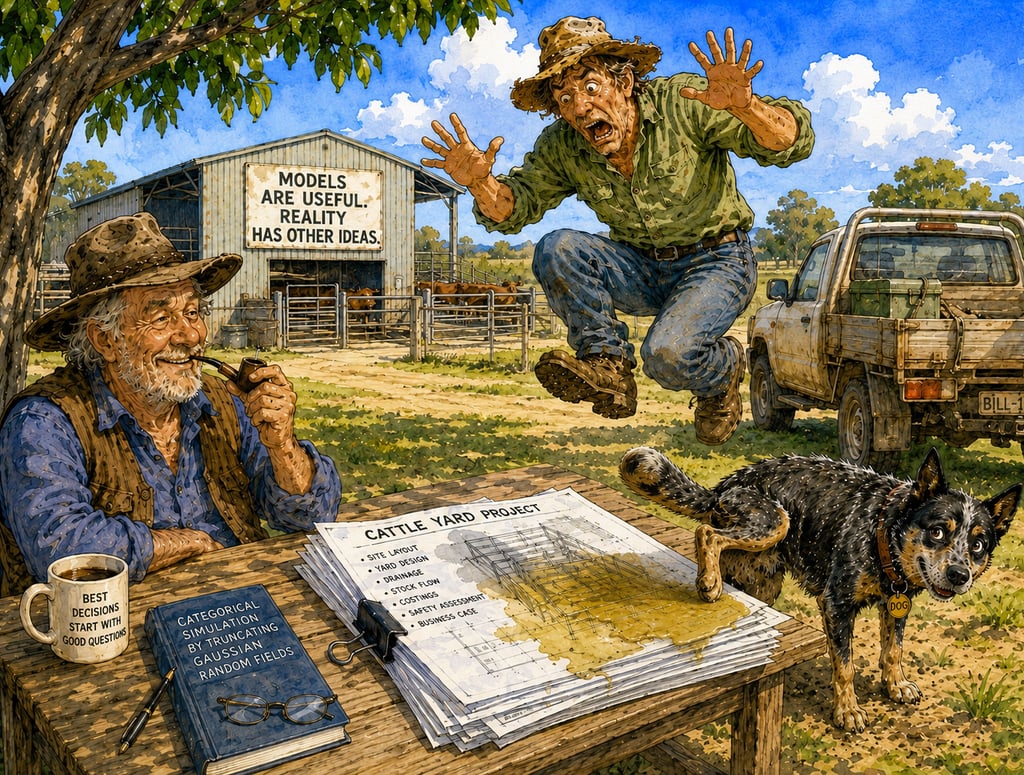
The Cattle Yards
Bill was sitting on the verandah reading a paper called Categorical Simulation by Truncating Gaussian Random Fields.
Tom pulled up in the ute.
“What are you reading?”
“Bit of light entertainment.”
Tom looked at the title.
“You know normal people watch the footy.”
“So I’ve heard.”
Dog wandered over to inspect the ute while Tom hauled a large folder from the passenger seat.
“This,” said Tom, dropping it on the table, “is my new cattle-yard project.”
Bill looked at the folder.
It was thick enough to stun a bullock.
“Where are the yards?”
“Not built yet.”
“So that isn’t the project.”
“It’s the plans for the project.”
“Ah.”
Tom opened the folder.
“Site layout. Yard design. Drainage. Truck movements. Animal handling. Construction costs. Operating costs. Safety assessment. Business case.”
“Impressive.”
“Best people I could find.”
Bill turned a few pages.
Colour drawings. Neat tables. Straight lines. Arrows showing cattle moving calmly through the yards as if they’d read the report.
Dog sniffed the back wheel of the ute, considered matters carefully, and cocked his leg.
The breeze took an unexpected interest in the open folder.
“DOG!”
Tom lunged for the papers.
Dog lowered his leg and looked surprised by the fuss.
Bill moved his pipe out of range.
“Well,” he said, “there’s your first review comment.”
Tom glared at him.
“He’s just weed on the drainage report.”
“Perhaps he found it unconvincing.”
Tom wiped the cover with his sleeve.
“This cost me a fortune.”
“I can see that.”
“And it’s not funny.”
“Not from where you’re standing.”
Tom shut the folder and sat down.
“So. What do you reckon?”
Bill tapped the cover.
“I reckon you’ve got a model.”
“It’s a feasibility study.”
“Same family.”
“It’s a set of cattle yards.”
“No. It’s a description of a set of cattle yards that doesn’t exist.”
Tom sighed.
“Fine. A model.”
Bill nodded.
“And before you use it to make a decision, you need to know whether the whole thing hangs together.”
“It does. Every report says so.”
“That’s not quite the same thing.”
Bill opened the folder again.
“First, there’s the idea of what these yards are meant to be.”
“The design.”
“More basic than that. What problem are they solving? What cattle? How many? What trucks? What weather? What sort of operation?”
Tom pointed to the summary.
“All in there.”
“Good. That’s your picture of the real system. Get that wrong and everything after it can be beautifully wrong.”
Tom nodded reluctantly.
“Then there’s the information.”
“Survey. Rainfall. Herd numbers. Truck sizes. Soil tests.”
“Measured?”
“Mostly.”
“Mostly is a useful word. Means some of it was measured and the rest was invited to the meeting.”
Tom ignored him.
Bill continued.
“Then there’s the analytical bit. The calculations. Drain capacity. Turning circles. Pen sizes. Costs. Throughput.”
“That’s all been done.”
“I’m sure it has. But the question isn’t whether someone ran the numbers. It’s whether they ran the right numbers on decent information for the system you actually have.”
Tom looked at Dog.
Dog had moved on to licking the bullbar.
“And then,” said Bill, “comes the bit people often pretend isn’t another model.”
“What bit?”
“The decision.”
Tom frowned.
“You either build it or you don’t.”
“Eventually. But how do you get there?”
Bill picked up a pencil.
“You’ve got cost, safety, cattle flow, reliability, wet-weather performance, neighbour impacts, future expansion and probably half a dozen other things.”
“Right.”
“Which matters most?”
“Safety.”
“Always?”
“Mostly.”
“What if the safest design costs twice as much and handles half the cattle?”
Tom paused.
“Well, then you balance it.”
“Exactly.”
Bill drew a rough table.
“You choose what matters. You decide how much each thing matters. You compare options. You set thresholds. You decide what uncertainty you’ll accept.”
“That’s just judgement.”
“Yes.”
“So where’s the model?”
“That is the model.”
Tom looked doubtful.
Bill pointed at the table.
“If you rank cost first, you get one answer. Put reliability first, you get another. Ignore wet-weather operation and a cheap design suddenly looks clever. Double-count safety in three different categories and another option wins.”
“So the decision can be biased.”
“Or inconsistent. Or built to favour the answer someone wanted before they opened the folder.”
Tom looked at the thick report.
“And all four parts have to work.”
“More or less.”
“The idea of the system.”
“Yep.”
“The information.”
“Yep.”
“The calculations.”
“Yep.”
“And the way the final choice is made.”
“Yep.”
Tom leaned back.
“And if one part is wrong?”
“You may build cattle yards that work poorly.”
“That’s hardly catastrophic.”
“No. Usually cattle yards just cost money, annoy cattle and teach people new swear words.”
Bill turned to another page.
“But the same process approves mines, dams, bridges, hospitals, factories and waste plants.”
Tom was quiet.
Bill continued.
“The problem isn’t always that one calculation is wrong. The bigger problem can be that the entire folder is an incomplete picture of what’s really going to be built and operated.”
Tom opened the approval section.
“The builder says some details may be refined during construction.”
Bill raised an eyebrow.
“Refined how?”
“Gate positions. Pen sizes. Materials. Operating arrangements.”
“So are you approving these yards?”
“Yes.”
“Or are you approving something broadly yard-shaped?”
Tom read further.
“Future livestock requirements may be accommodated.”
Bill nodded.
“Cattle?”
“Presumably.”
“Sheep?”
“Maybe.”
“Goats?”
“Possibly.”
“Alpacas?”
Tom laughed.
“Don’t be stupid.”
“Does it rule them out?”
Tom kept reading.
“No.”
Bill sat back.
“There you are.”
“What?”
“You approve a cattle-yard model, then five years later someone tells you the alpaca run is merely a minor operational refinement.”
Dog wandered back and placed his head on Tom’s knee.
Tom scratched behind his ears despite himself.
“So what should I ask before I approve it?”
Bill held up four fingers.
“What part of the real operation isn’t in the folder?”
“What important conclusions depend on assumptions instead of evidence?”
“What happens where the different parts interact?”
“And will the contract make them build and operate the thing you assessed, rather than something that still fits the heading?”
Tom looked at the damp mark on the drainage report.
“And Dog?”
Bill glanced down.
“Dog’s the bit nobody modelled.”
Dog thumped his tail.
Bill picked up his paper again.
“Sometimes that’s harmless.”
“And sometimes?”
Bill turned the page.
“Sometimes reality cocks its leg on the whole project.”
What Bill Was Really Saying
Dog wasn't the point.
The plans weren't the point either.
Bill's point was much bigger.
Whenever we make an important decision about something that doesn't yet exist, we're making that decision from a model of the future.
That model might be a set of engineering drawings.
It might be a business case.
It might be computer modelling.
Or it might be an entire development application.
The question isn't whether the model looks professional.
Most do.
The question is whether it is a complete and reliable enough representation of reality to justify the decision that follows.
Good decision-makers understand there are really four parts to that process.
First, have we correctly understood the real problem?
Second, do we have enough reliable evidence?
Third, have we represented that evidence properly in our reports, calculations and models?
Finally—and this is the part many people miss—how are we actually using all that information to make the decision?
A beautiful model built on poor evidence is still poor.
Excellent evidence answering the wrong question is still the wrong answer.
And even excellent models can produce poor decisions if we give too much weight to some things and ignore others.
That's why Bill wasn't admiring Tom's folder.
He was asking whether it was enough.
Enough to spend the money.
Enough to build the yards.
Enough to live with the consequences if they were wrong.
Why this matters for Glan Devon
The proposed Glan Devon development is no different.
The Development Application is itself a model.
It is a prediction of a future waste-receiving, waste-burning, biosolids-processing and fertiliser-manufacturing operation.
Council, SARA and the community aren't deciding whether the reports are neatly written.
They're deciding whether those reports collectively provide a sufficiently complete and reliable picture of what will actually be built and operated.
That leads to four simple questions.
1. What parts of the future operation aren't represented?
Every model leaves something out.
The important question is whether anything left out could change the decision.
2. Which conclusions rely on assumptions rather than demonstrated evidence?
Assumptions aren't bad.
Hidden assumptions are.
Decision-makers should know which conclusions are supported by measurements and which depend on predictions or expectations.
3. What happens where all the parts interact?
Air quality.
Traffic.
Waste handling.
Biosolids.
Stormwater.
Noise.
Economics.
None of these operate in isolation.
The real facility will be a single operating system, not a folder full of separate reports.
4. Does the approval actually lock the project to the version that has been assessed?
Or could important aspects change later while still remaining within a broadly worded approval?
That isn't a criticism.
It's simply one of the questions good decision-makers ask before approving any major project.
The real lesson
It is easy to admire a well-prepared model.
It is much harder to ask whether it is a fair representation of reality.
That's why Dog mattered.
He didn't care how impressive Tom's folder looked.
He simply reminded everyone that sooner or later reality turns up.
And reality has a habit of asking questions that never appeared in the reports.
© 2026. All rights reserved.