Bill and Tom and the tractor with no official problem
Arms length does not mean ears closed
Scott Dunham
7/5/20264 min read
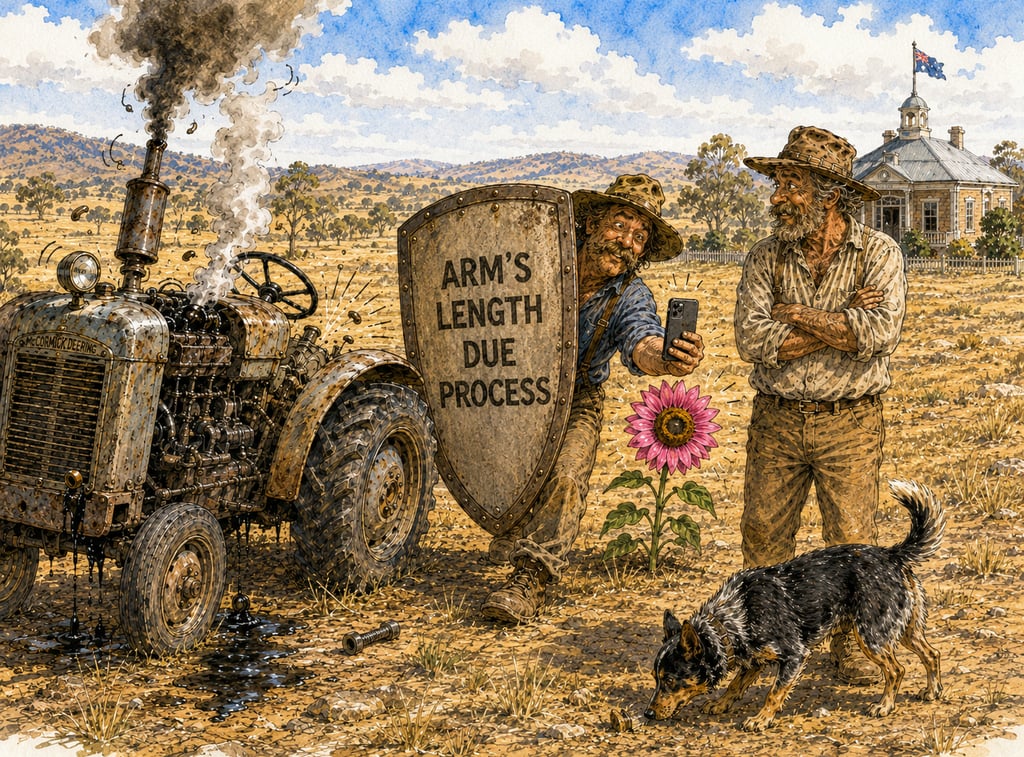
Bill found Tom standing beside his old tractor with a cup of tea in one hand and a phone in the other.
The tractor was making a knocking sound.
Not a small knock. Not a polite knock. It was the sort of knock that made birds leave nearby trees and made mechanics quietly update their hourly rate.
There was oil under it.
There was smoke above it.
There was a bolt on the ground.
Tom was taking a photo of a pink sunflower.
Bill looked at the tractor.
Then at Tom.
“Problem?” Bill asked.
Tom didn’t look up.
“No official problem.”
The tractor knocked again.
Something inside it squealed, then stopped squealing in a way that suggested it had given up.
Bill pointed at the oil.
“That looks like a problem.”
Tom shook his head. “The tractor has not come before the shed yet.”
“The shed?”
“For formal assessment.”
Bill waited.
Tom took another photo of the sunflower.
“Lovely community colour,” he said.
The tractor coughed blue smoke over both of them.
Bill waved it away.
“Tom, the thing is leaking, smoking and knocking.”
“I understand people have concerns.”
“People?”
“Well, you.”
“I’m not people. I’m Bill.”
“Still. Your opportunity to raise concerns will come when the tractor enters the proper inspection process.”
Bill stared at him.
A bolt rolled gently down the yard.
Tom watched it go.
“Probably not material.”
Bill picked it up.
“It fell off the tractor.”
“Allegedly.”
“It landed on my boot.”
“Still, we must not prejudge.”
Bill put the bolt on the bench.
“Not prejudging means you don’t decide the repair before looking. It doesn’t mean you pretend the tractor is fine while bits of it migrate across the yard.”
Tom frowned.
“I have to stay at arm’s length.”
Bill looked down.
“The oil is touching your boot.”
Tom moved his boot.
“Better.”
Bill took the phone from Tom and pointed it at the tractor.
“Here’s your community update.”
Tom reached for it. “Don’t.”
Bill read aloud as he typed.
Great morning in the yard. Wonderful to see the tractor engaging so strongly with the community. Some residents have expressed views about smoke, oil and metallic noises. The tractor has not yet come before the shed. Everyone will get their chance to comment later.
Tom snatched the phone back.
“That’s ridiculous.”
“Yes,” Bill said.
“That makes me sound useless.”
Bill said nothing.
Tom looked at the tractor.
It knocked again.
Bill picked up the job book from the bench and opened it.
Tom groaned.
“You and that bloody notebook.”
Bill wrote:
Concern raised: engine knocking.
Tom said, “You can’t write that. It hasn’t been assessed.”
“I’m not assessing it. I’m recording it.”
“That creates expectations.”
“So does smoke.”
Bill wrote again.
Concern raised: oil leak.
Concern raised: loose bolt found under tractor.
Concern raised: blue smoke.
Tom folded his arms.
“You’re going to make people think something is wrong.”
“No,” Bill said. “The tractor is doing that.”
Tom looked offended on behalf of the machinery.
Bill tapped the page.
“This doesn’t decide the answer. It doesn’t say the tractor is finished. It doesn’t say which part failed. It doesn’t even say you’re to blame, though I reserve the right.”
“Generous.”
“It just says: here are the symptoms, here is where they belong, and here is what needs checking.”
Tom looked at the book.
Bill drew three columns.
Concern. Assessment area. Possible control.
Then he filled them in.
Knocking. Engine. Diagnose before use.
Oil leak. Sump, seals, lines. Find source and repair.
Blue smoke. Rings, breather, oil level. Test and inspect.
Loose bolt. Anything that should remain attached. Find where it came from.
Tom scratched his chin.
“So the job book doesn’t fix the tractor.”
“No.”
“It doesn’t decide the tractor is ruined.”
“No.”
“It just stops everyone pretending the symptoms weren’t reported.”
Bill nodded.
“Now apply that to council.”
Tom sighed. “I knew it.”
Bill kept going.
“When the mayor says the projects have not come before council yet, people may understand the formal decision has not happened. Fine.”
Tom nodded.
“But when she says that, then says people will get their chance later, and councillors are staying at arm’s length, it sounds like something else.”
“What?”
“It sounds like: be quiet, your turn will come.”
Tom said nothing.
Bill pointed at the job book.
“That is the problem. People are not asking council to make the final decision today. They are asking council to stop acting like their concerns do not exist until public notification opens.”
Tom looked at the tractor.
Bill continued.
“Odour is not just noise from the public. It maps to amenity, waste handling, storage, ventilation, monitoring and shutdown controls.”
“Trucks?”
“Road safety, haulage routes, hours, pavement damage, amenity.”
“PFAS?”
“Feedstock acceptance, product testing, residue handling, contaminant limits, environmental regulation.”
“Stormwater?”
“Containment, runoff, water quality, rainfall events, emergency storage.”
Tom nodded slowly.
“So council could keep a job book.”
“Exactly.”
“Concern raised. Where it maps in the assessment. What evidence is needed. What controls might apply. Where it will be answered.”
“Yes.”
“And that doesn’t prejudge the application.”
“No.”
“It just proves council heard the knock.”
Bill smiled faintly.
“There’s the sentence.”
The tractor gave another loud metallic clank.
Tom looked at it.
Then he looked at the sunflower photo on his phone.
“Bit awkward posting lovely yard updates while the tractor’s coughing itself to death.”
“Only if people can see the smoke.”
“They can.”
“Then yes.”
Tom closed the phone.
Bill handed him the job book.
Tom read the first line.
Arm’s length does not mean ears closed.
Underneath, Bill had added:
Public notification is not the first moment people matter.
Tom looked at the tractor.
The tractor knocked again.
This time, Tom wrote it down.
Join the conversation here:
What Bill is really saying
Bill is not saying council should prejudge the application.
He is saying that “due process” should not be used as a polite way of telling people to be quiet until later.
When a community raises concerns about odour, trucks, PFAS, stormwater, land-use conflict or long-term impacts, those concerns should be heard, recorded and mapped to the assessment process.
That does not mean council agrees with every concern.
It does not replace formal submissions.
It does not decide the outcome.
It simply shows people where their concern goes, who will assess it, what evidence is needed, and what controls may be required.
Public notification is important. People still need to make proper submissions when the time comes.
But public notification is not the first moment people matter.
Arm’s length does not mean ears closed.
© 2026. All rights reserved.