Did the pie get bigger or did money just move?
Bill explains 'Economic Output' verses 'Economic Benefit' and why the two are not the same.
Scott Dunham
6/30/20267 min read
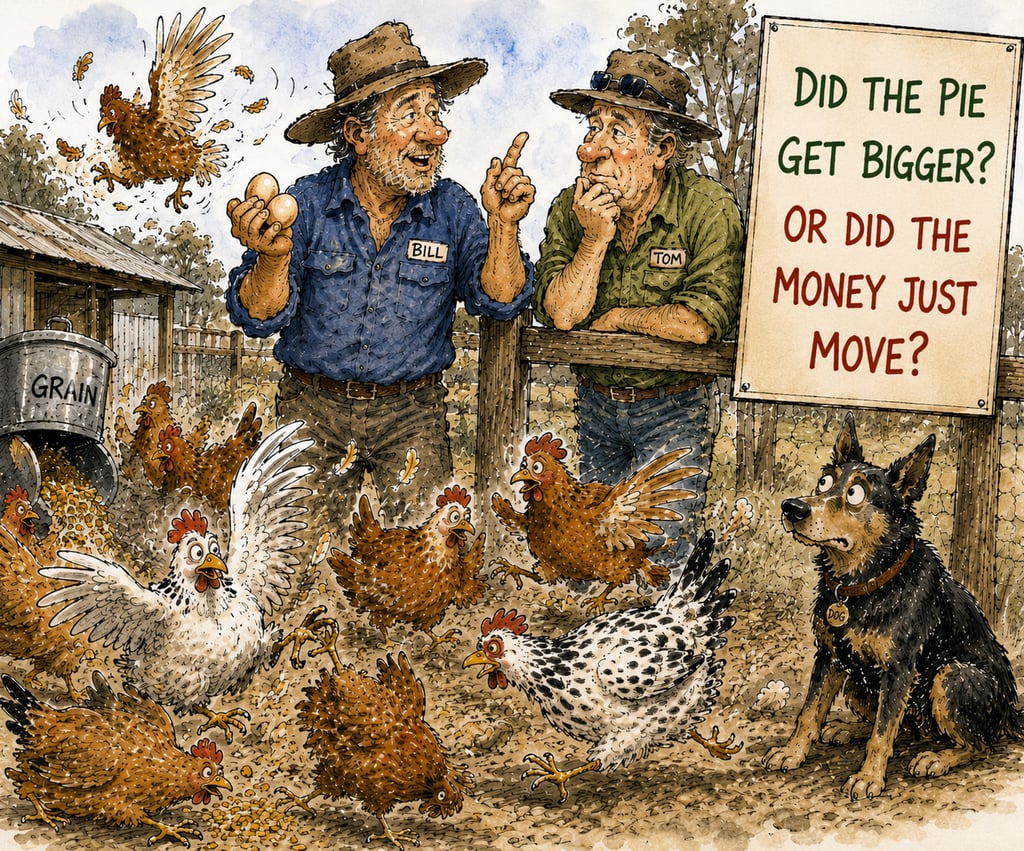
Bill was standing beside the chook pen with a tin plate in one hand and a half-eaten slice of apple pie in the other.
Tom came down from the house with a folder under his arm.
The dog followed Tom, not because he cared about the folder, but because he had noticed the pie.
Bill looked at the folder.
“No,” he said.
“You don’t even know what it is.”
“It’s paper. Paper means trouble.”
“It’s the economic impact section for the Glan Devon biosolids plant.”
Bill looked at the chooks.
The chooks looked back at Bill.
The dog looked at the pie.
Tom opened the folder. “The applicant says the facility is anticipated to generate sixteen and a half million dollars in total regional economic output per year, and eighteen ongoing local jobs.”
Bill nodded.
“Sounds impressive,” Tom said.
“It does,” Bill said. “So does a chook trying to fly over a gate. Doesn’t mean she’s gone anywhere useful.”
Tom frowned. “The report says the project would generate economic activity.”
Bill walked to the feed drum, lifted the lid, and scooped out a tin of grain.
“Watch this.”
He tossed the grain into the pen.
The chooks exploded.
They came from every direction. White ones, brown ones, one speckled hen with the permanently offended expression of a retired schoolteacher. They scratched. They flapped. They chased each other. One hen grabbed a piece of corn and ran as if she had stolen gold. Another chased her, ignoring the same corn scattered at her own feet.
The rooster puffed himself up and strutted through the middle of it all, pretending he had arranged the event.
Dust rose. Feathers lifted. The water tin rocked.
The dog pressed his nose against the wire and whined.
Bill pointed with the pie.
“There you are.”
“There I am what?”
“Economic activity.”
Tom watched the chooks tearing around the pen.
“That’s not economic activity. That’s chooks making a mess.”
“Same problem, different report.”
Tom closed the folder halfway.
Bill leaned on the fence.
“Plenty happening in there, isn’t there?”
“Yes.”
“Movement everywhere.”
“Yes.”
“Noise, urgency, winners, losers, flow-on effects.”
“They’re chooks, Bill.”
“Exactly. Easier to understand than most modelling.”
A hen tried to stand on another hen’s back to reach grain on the fence rail. Both hens fell over. The rooster crowed, late and without purpose.
Bill said, “If I wrote this up properly, I could make it sound grand. Grain introduced into the system. Immediate response across the poultry sector. Increased scratching activity. Strong engagement from local hens. Flow-on effects observed in dust movement, water displacement and dog interest.”
The dog wagged his tail.
“But none of that tells me whether the farm is better off,” Bill said.
“No.”
“It tells me there was movement. It doesn’t tell me whether the pie got bigger.”
Bill held up the remains of the apple pie.
Tom looked from the pie to the chooks.
“That’s the point?”
“That’s the first point.”
Bill broke a crumb from the crust and gave it to the dog, who accepted it with the seriousness of a magistrate receiving evidence.
“Money moving around is not the same as value being created,” Bill said. “That sixteen and a half million dollar number may describe flows through a model. It does not mean the district is sixteen and a half million dollars richer.”
Tom looked back at the folder.
“But if money is being spent, doesn’t that help?”
“Sometimes. Depends what changed.”
Bill took another bite of pie.
“Suppose I give you ten dollars to buy grain.”
“Right.”
“You buy grain from the feed store. The feed store pays the driver. The driver buys lunch. The lunch shop pays staff. The staff buy groceries. Around it goes.”
“That’s the multiplier idea.”
“Near enough.”
“So there is activity.”
“Yes.”
“But?”
“But where did the ten dollars come from?”
Tom paused.
Bill pointed the pie at him.
“If you were going to spend that ten dollars at Jim’s hardware, and now you spend it at the feed store instead, the feed store is happier. Jim isn’t. The district may not be ten dollars richer. The money may have just changed direction.”
Tom said nothing.
Bill nodded toward the chooks.
“Same in there. That speckled hen looks like she’s won because she pinched the corn. But the pen hasn’t got more corn. She’s just got what another chook might have eaten.”
The speckled hen ran behind the nesting box with her prize.
The dog sneezed.
Bill continued.
“Or suppose the new project hires a bloke.”
“One of the eighteen jobs?”
“Maybe. Good for him, perhaps. But what if he was already working for another local business? What if that business lost work to the newcomer, or lost staff because it couldn’t match the wages? Then the district hasn’t automatically gained a worker. It may have moved one.”
Tom tapped the folder against his leg.
“So the headline number does not tell us whether the pie grew.”
“No.”
“It tells us money moved.”
“It tells us the model expects money to move, under the assumptions used.”
“That’s narrower.”
“It usually is.”
The chooks were settling now. A few still scratched. The rooster had found a raised patch of dirt and stood on it as if preparing to address the district.
Bill glanced at him.
“Don’t start.”
The rooster started anyway.
Tom opened the folder again. “So if Council sees the sixteen and a half million number, what should they ask?”
Bill wiped his fingers on his shirt.
“They should ask the egg-basket questions.”
“The what?”
“The egg-basket questions.”
Bill opened the gate, stepped into the pen, and lifted the lid of the nesting box. Two eggs sat in the straw.
He picked them up and came back out.
“Here,” he said. “This is what matters after the flapping stops.”
He held up the eggs.
“First question: what is the actual direct local benefit? Not the modelled flow. The real thing. How many local jobs? How many permanent jobs? How much local spending? How much local value stays here?”
Tom nodded.
“Second: what changes elsewhere? Does another local business lose work? Does an existing contractor lose a contract? Does someone else lose staff? Does the project grow the pie, or just cut the same pie differently?”
The dog sat down at the word pie.
“Third: what leaks out? Are the owners local? Are the engineers local? Is the equipment local? Are the specialist workers local? Or does the big number pass through town like a truck on the highway?”
Tom looked toward the road.
“Fourth: what costs are not in the number? Roads, complaints, monitoring, odour, dust, water risk, staff time, neighbours’ amenity, business confidence. If those costs sit outside the model, the model has not answered the planning question.”
Bill held up the eggs again.
“Fifth: what would happen instead? Same land, same roads, same workers, same council attention. What other use is being pushed aside?”
Tom said, “Opportunity cost.”
Bill gave him a look.
“Don’t say that near the chooks. They’ll form a committee.”
The rooster scratched once, then looked as if he might.
Bill shut the gate.
“The point is simple,” he said. “A planning decision is not made on whether a report can show movement. Any project with trucks, wages, invoices and suppliers can show movement. The question is whether there is a durable net gain to the district after the costs, risks, leakages and alternatives are counted.”
Tom looked again at the report.
“And based on the sixteen and a half million number alone, we don’t know that.”
“No.”
“It could be a real net gain.”
“Maybe.”
“It could be small.”
“Maybe.”
“It could be just money moving around.”
“Maybe.”
“It could even be negative if the costs and impacts are bigger than the retained benefit.”
“Also maybe.”
Tom closed the folder.
“That’s not much of a headline.”
“No,” Bill said. “But it’s closer to the truth.”
The dog stood and put one paw gently on Bill’s boot.
Bill looked down.
“You’ve had your crumb.”
The dog did not move.
Bill sighed and broke off another piece of crust.
Tom watched the chooks return to ordinary scratching. The dust settled. The water tin stopped rocking. The rooster lost interest in public life and wandered toward the shade.
Bill put the two eggs into Tom’s hand.
“Remember this,” he said. “The model can count the grain, the scratching, the feed bill, the truck, the shop, the diesel and the lunch bought by the driver. That can be useful, if you know what it is.”
“But it can’t tell you whether the farm is better off.”
“Not by itself.”
“And it can’t tell you whether the chook pen belongs beside the house.”
“Exactly.”
Bill tapped the folder once with his finger.
“For Glan Devon, the question is not whether money moves. Of course money moves. The question is what remains here, who benefits, who carries the costs, what gets displaced, and whether the district is actually better off.”
Tom looked at the eggs in his hand.
“And the sixteen and a half million?”
Bill took the last bite of pie.
“That’s the flapping,” he said. “Don’t confuse it with the egg basket.”
Join the conversation here:
What Bill is really saying
Just because a number appears in a model, and the model appears in a report, does not mean the model is answering the question people think it is answering. Numbers and models can look and sound impressive but they may just be misleading.
The applicant’s website says the Glan Devon facility is anticipated to generate $16.5 million in total regional economic output per year. That sounds like a measure of benefit. But economic output is not the same thing as net gain to the district.
The important question is not simply:
How much money moves through the project?
The better question is:
Is the district actually better off after the project is operating?
Those are different questions. Money moving through a project may not be money staying in the district.
An input-output model can estimate how money may flow through suppliers, wages, contractors and related spending. But that does not prove the regional “pie” has grown. Some of the money may have been spent elsewhere in the district anyway. Some may leave the region through outside suppliers, specialist contractors, equipment purchases, finance, ownership or profit. Some jobs may be people moving from existing local businesses rather than new workers added to the district economy.
So the $16.5 million figure should not be read as meaning the South Burnett is $16.5 million richer each year. It is a modelled flow of economic activity, not a demonstrated net local benefit.
For a planning decision, the questions should be more practical:
What new local value remains in the district?
How many jobs are genuinely local, ongoing and additional?
What existing businesses or activities may lose out?
What costs fall on roads, neighbours, council, amenity and compliance?
What risks are being accepted, and by whom?
What other uses of the land, labour and public attention are being pushed aside?
Based on the headline economic output number alone, the net benefit is unknown.
It could be positive. It could be small. It could mostly be money moving around. It could even be negative if the costs and impacts outweigh the value retained locally. The headline number $16.5 million sounds impressive but it's not a measure of value gained, it's a measure of money moving around.
That is Bill’s egg-basket lesson: don’t confuse flapping with eggs.
Join the conversation here:
© 2026. All rights reserved.