Dog and the cowpat
Do facts answer questions? That depends on the question. Some simple ideas on checking before making a judgement.
7/18/20267 min read
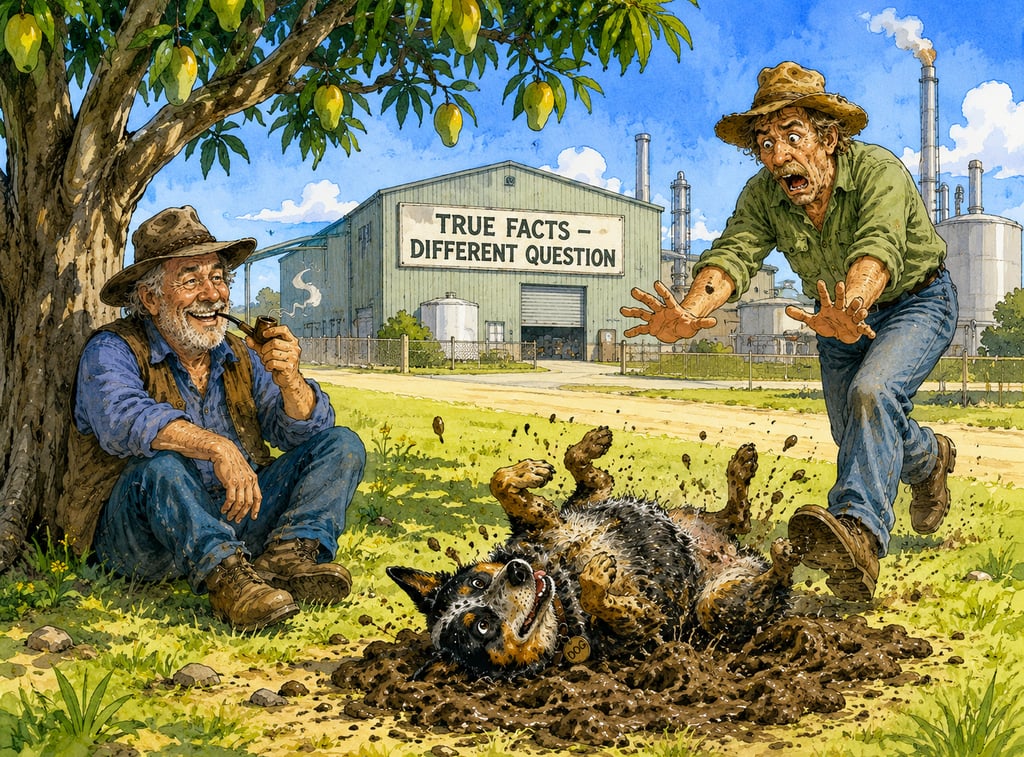
Tom was sitting under the mango tree with a stick in his hand, drawing boxes in the dirt.
Bill stopped beside him.
“That usually means trouble.”
“I’ve been reading about a proposal.”
“That confirms it.”
Tom ignored him.
“Bloke wants to build a cattle holding yard on the edge of a city. Cattle come in from the country, stay for a while, get sorted, fed and loaded out again.”
“Near houses?”
“Some.”
Bill took out his pipe.
“And?”
“I can’t work out why the arguments for it bother me. The facts seem right.”
Bill looked at the dirt.
“Maybe they are.”
Tom frowned.
“Then why does the reasoning feel wrong?”
Bill sat on the fence rail.
“Maybe the facts are answering the wrong question.”
Tom stopped scratching.
“What?”
“Show me.”
Tom wrote:
THERE IS ALREADY A FREIGHT DEPOT NEARBY
“So,” he said, “the area already has commercial activity.”
“True?”
“Yes.”
“And what question does that answer?”
Tom thought.
“Is there already commercial activity nearby?”
“Exactly.”
Tom waited.
Bill puffed on his pipe.
“That wasn’t very difficult.”
“No.”
“What’s the actual question?”
Tom looked back at the imaginary cattle yard.
“Whether a cattle holding yard is acceptable there.”
“Same question?”
Tom stared at the dirt.
“No.”
He wrote:
EASY QUESTION:
Is there already commercial activity nearby?
HARD QUESTION:
Is this particular operation acceptable in this particular place?
“That’s annoying,” said Tom.
“Thinking often is.”
Tom tapped the first question.
“So I can answer this perfectly.”
“Yes.”
“With true facts.”
“Yes.”
“And still not answer the question that matters.”
Bill nodded.
Dog was nearby.
Dog had found a cowpat.
This was surprising only because there were no cattle anywhere nearby.
Dog considered this evidence of extraordinary good fortune.
Tom drew another line.
“The road is already busy. Trucks use it all day.”
“True?”
“Yes.”
“So a few more trucks shouldn’t matter much.”
Bill raised an eyebrow.
Tom stopped.
“Wrong question again?”
“What question have you answered?”
Tom sighed.
“Does the road already carry heavy traffic?”
“And the real question?”
“Can it safely and reasonably carry the additional traffic.”
“Same question?”
“No.”
Tom wrote:
EASY QUESTION:
Does the road already carry trucks?
HARD QUESTION:
What happens when we add this extra traffic to the traffic already there?
He stared at it.
“The road could have plenty of spare capacity.”
“Yes.”
“Or it could be close to the point where another fifty truck movements start causing queues every afternoon.”
“Yes.”
“So ‘it already happens’ does not answer ‘what happens if we add more’.”
“Correct.”
Dog lowered one shoulder towards the cowpat.
Tom pointed the stick at him.
“Don’t.”
Dog paused.
This was not obedience. It was reassessment.
Tom returned to the dirt.
“Next argument. There are cattle yards and feedlots out west ten times bigger than this one.”
“Probably.”
“So this one is small.”
“Yes.”
“And therefore…”
Tom stopped.
Bill smiled.
“Oh, bugger.”
“Go on.”
Tom wrote:
EASY QUESTION:
Are there much bigger facilities somewhere else?
“Answer?”
“Yes.”
“Hard question?”
Tom wrote:
Is this facility acceptable here?
He sat back.
“They’re barely related.”
“Size might be relevant.”
“But it isn’t the whole question.”
“No.”
“Different place. Different neighbours. Different roads. Different water. Different consequences.”
Bill nodded.
“So I can prove that something much bigger exists somewhere else and still know almost nothing about whether this smaller thing belongs here.”
“Now you’re getting somewhere.”
Dog sniffed the cowpat again.
Tom pretended not to notice.
“One more,” he said.
“Of course.”
“Drought and lack of agistment are serious problems for farmers.”
“True?”
“Absolutely.”
“So a cattle holding yard helps.”
“Does it?”
Tom hesitated.
“Well. It’s a cattle facility.”
“That wasn’t my question.”
Tom sighed and started writing.
EASY QUESTION:
Is drought and lack of agistment a real problem?
ANSWER:
Yes.
Then:
HARD QUESTION:
Does this particular proposal materially help solve that problem?
Tom looked at Bill.
“Not necessarily.”
“Why not?”
“It might be a purely commercial operation. The cattle might come from anywhere. It might not take drought-affected cattle at all.”
“So the problem can be real.”
“Yes.”
“The facts about the problem can all be true.”
“Yes.”
“And the project can still have bugger-all to do with solving it.”
Tom looked at the four examples in the dirt.
For a while neither man said anything.
Then Tom drew:
HARD QUESTION
↓
EASIER QUESTION
↓
TRUE FACTS
↓
CORRECT ANSWER
↓
WRONG DECISION
Bill looked at it.
“Not always a wrong decision.”
Tom nodded.
“Fair point.”
He crossed out the last line and wrote:
ANSWER TREATED AS IF IT SOLVED THE HARD QUESTION
Bill nodded.
“That’s better.”
Tom sat back on his heels.
“So that’s the trick.”
“What trick?”
“The hard question takes work. It might need evidence. Comparisons. Modelling. Thinking about consequences.”
“Yes.”
“So we quietly swap it for an easier question.”
“Sometimes.”
“Then we answer the easier question with perfectly good facts.”
“Yes.”
“And because the facts are true, the answer feels solid.”
Bill nodded.
“But it may have almost nothing to do with the question we were supposed to decide.”
“Exactly.”
Tom looked uncomfortable.
“That’s more dangerous than simply getting a fact wrong.”
“Why?”
“Because a wrong fact can be checked.”
Bill smiled.
“And a wrong question?”
“Might never be noticed.”
Behind them came a soft, satisfied grunt.
They turned.
Dog had committed.
He was flat on his back in the cowpat, twisting enthusiastically from side to side.
Tom closed his eyes.
Bill took the stick.
Underneath Tom’s diagram he wrote:
QUESTION:
What should I do with this excellent-smelling cowpat?
↓
COWPAT EXISTS
↓
SMELLS EXCELLENT
↓
ROLL IN IT
Dog stood up.
He looked extremely pleased with himself.
Tom looked at Bill.
“The facts are right.”
“Yes.”
“Dog answered his question correctly.”
“From Dog’s point of view.”
Tom narrowed his eyes.
“Something’s missing.”
Bill added one final line:
HARDER QUESTION:
What happens after I roll in it?
↓
DOG BATH
Dog heard the word bath.
His ears dropped.
For the first time that afternoon, he appeared to reconsider the quality of the question he had asked.
Then he ran.
Tom dropped the stick and went after him.
Bill watched them disappear around the shed.
The facts had been right.
The answers had been right.
The questions had been the problem.
Why This Matters for the Glan Devon Development Application
The little yarn about Bill, Tom and Dog wasn’t really about cattle yards.
It was about how people make decisions.
The Glan Devon Development Application raises some difficult questions. They are difficult because they involve planning law, engineering, environmental science, economics, transport, agriculture and community expectations.
Hard questions are… well… hard.
Nobel laureate Daniel Kahneman’s work on judgement suggests that people sometimes unconsciously replace a difficult question with an easier one. The easier question is simpler to answer, easier to find facts for and easier to explain. Our minds may then connect the easy question and the hard question as though they were the same.
One example from Daniel Kahneman’s work is the famous “Linda” question. People were told that Linda was intelligent, outspoken and deeply concerned with issues of social justice. They were then asked which was more likely:
Linda is a bank teller.
Linda is a bank teller who is active in the feminist movement.
Most people chose the second answer because it seemed to fit the description better. Logically, however, it cannot be more likely. Every feminist bank teller is also a bank teller, so the first statement must be at least as probable as the second.
Kahneman argued that many people had unconsciously substituted the difficult question—“Which option is statistically more probable?”—with the much easier question—“Which option sounds more like Linda?”
The same thing can happen in planning and public policy. Facts may provide a convincing answer to an easier question, while the harder question that actually has to be decided remains unanswered.
That can happen without anyone intending to mislead. It is simply one of the ways human thinking sometimes works.
So here is a simple test that anyone can apply—to the applicant, to objectors, to Council officers, to SARA, to expert reports and even to their own thinking.
Step 1 — What is the actual decision question?
For example:
Is this particular development appropriate at this particular location?
Will this development have acceptable environmental impacts?
Does this proposal genuinely benefit the South Burnett community?
Is the proposal consistent with the planning scheme?
Those are the questions that ultimately matter.
Step 2 — What question do the presented facts actually answer?
Perhaps the facts show that another waste-related activity already exists somewhere.
Perhaps they show that roads already carry trucks.
Perhaps they show that larger facilities exist elsewhere.
Perhaps they show that landfill capacity is becoming a problem.
Perhaps they show that the technology works under certain conditions.
Those facts may all be true. But they may not be addressing the hard question.
The important question is:
What question do those facts actually answer?
Step 3 — Are those the same questions?
If the answer is yes, the reasoning has at least addressed the right question.
If the answer is no, there may be a substituted question hiding in the argument.
That does not automatically make the conclusion wrong.
It simply means the conclusion has not yet been demonstrated.
Some examples
The hard question might be:
Is this development suitable for this location?
But the easier substituted question might be:
Is there already another waste-related activity nearby?
Those are not the same question. The existence of a nearby waste activity does not demonstrate this location is suitable for the proposed development.
The hard question might be:
Can Barkers Creek safely absorb any additional environmental pressure?
But the easier substituted question might be:
Does something already enter Barkers Creek?
Again, those are not the same question. Indeed, an existing discharge could make the harder question more important, because the relevant issue may be the cumulative pressure on the creek—not merely whether something already enters it.
The hard question might be:
Is this proposed technology, operating at this scale and with these feedstocks, acceptable at this location?
But the easier substituted question might be:
Are there larger facilities somewhere else?
The existence of a larger facility elsewhere may be true, but it does not answer whether this technology is appropriate in this location.
The hard question might be:
Does this proposal materially solve South Burnett’s waste problem?
But the easier substituted question might be:
Is landfill capacity becoming a problem?
The landfill problem may be real. That still does not prove that this proposal materially solves it. If the facility does not use wastes from the South Burnett, it is solving someone else’s problem while the risk transfer to the local district.
Notice something important.
Every easier question might have a perfectly good answer.
Every fact might be completely true.
But those answers do not automatically answer the harder question.
The lesson
The quality of a decision depends on more than the quality of the facts.
It also depends on whether the facts are answering the right question.
If Glan Devon is approved, it should be because the evidence answers the difficult planning, environmental and engineering questions that the law requires.
If it is refused, it should be for exactly the same reason.
That is good decision-making.
Not because it reaches a particular conclusion, but because it answers the right question.
© 2026. All rights reserved.