Dog takes a catch and the rule of law
Why Council can't just say NO
Scott Dunham
7/13/20265 min read
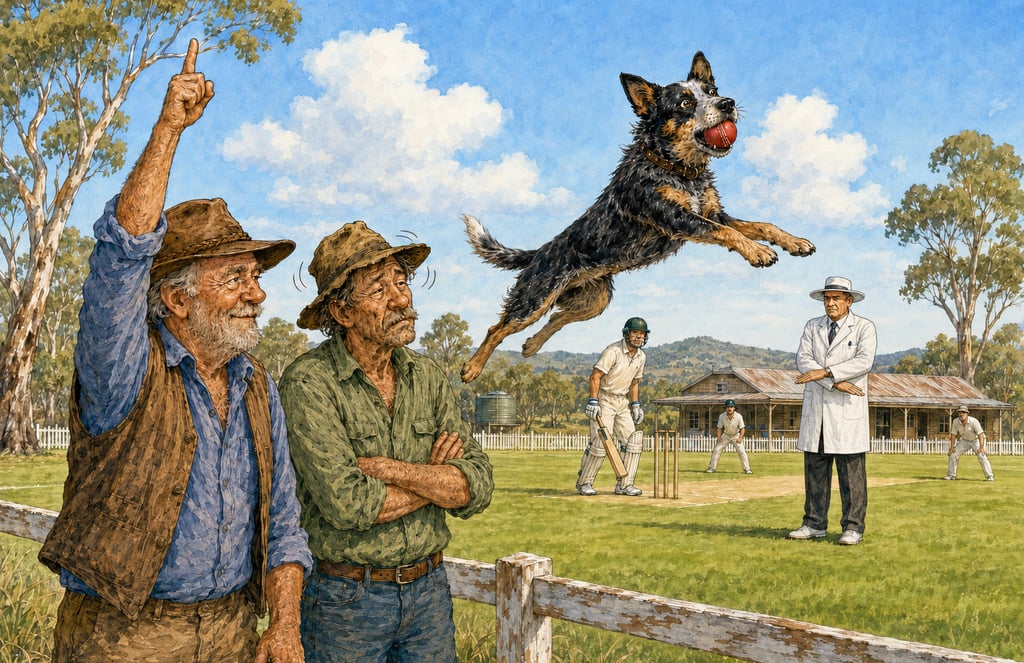

The annual Glan Devon cricket match was entering its serious phase.
Fred Lawson was batting. Cec Murphy was umpiring. Bill, elected president of the cricket club, stood near the scorer’s table offering Cec the benefit of his administration.
Tom sat in the shade.
Dog slept beneath the table.
Fred hit the next ball high over midwicket.
Dog woke.
He saw the ball, left the scorer’s table at speed and caught it cleanly in his mouth.
The crowd erupted.
“OUT!” shouted Bill.
Cec called dead ball.
Fred stayed at the crease.
“That was a clean catch,” said Bill.
“By Dog,” said Tom.
“Best catch we’ve seen all day.”
“He’s not playing.”
Bill turned towards the crowd.
“All those who reckon Fred’s out?”
Nearly every hand went up.
“There,” said Bill. “Overwhelming.”
“That’s a popular decision,” said Tom. “Not one available to the umpire.”
“It’s cricket, not the Supreme Court.”
“Still has rules.”
Bill pointed at Dog, who was now beneath the scorer’s table chewing the evidence.
“Everyone saw him catch it.”
“Nobody disputes the catch. Dog still isn’t a fielder.”
“So the truth doesn’t matter?”
“The catch is true. It just answers the wrong question.”
Bill looked at Fred.
Fred was not widely liked. He had once objected to the quality of the afternoon tea and produced written notes.
“The people have spoken,” said Bill.
“The people don’t decide whether Fred is out.”
“What’s the point of having a crowd?”
“Atmosphere. Afternoon tea. Uninformed advice.”
“I’m the elected club president.”
“You are.”
“Cec should listen to me.”
“He can listen. He still has to apply the competition rules.”
“Then we’ll change the rule.”
“You can’t change it halfway through the match.”
“I’m president.”
“You can decide what the club charges for beer and who mows the oval. The district association sets the competition rules.”
Bill frowned.
“So they have more power than me?”
“Different power. They make the rules for the competition. Cec makes decisions within them.”
“That doesn’t seem democratic.”
“It will when you’re batting.”
Fred resumed his innings.
Several overs later, he was dismissed by a registered player. The crowd applauded this less enthusiastically.
After lunch, Bill went in to bat.
His first few shots suggested lunch had been generous.
Then he edged one towards Fred at slip.
Dog saw the ball.
Dog remained interested in cricket and had received no notice of his disqualification.
He charged onto the field. The ball struck him on the shoulder, bounced into the air and landed in Fred’s hands.
“How’s that?” shouted Fred.
“OUT!” yelled the crowd.
Cec called dead ball.
Bill remained at the crease.
Fred objected.
“Clean catch.”
“Hit Dog,” said Bill.
“Dog didn’t touch the ground.”
“Dog’s not a player.”
Tom looked at Bill.
“He wasn’t a player when he caught Fred’s ball either.”
Bill looked towards the crowd.
Most hands were raised.
“Seems the people have spoken again,” said Tom.
“Cec made the right decision,” said Bill.
“Of course.”
“So the rules protect both sides.”
“That’s why Cec doesn’t rewrite them according to who the crowd dislikes.”
“What if the rule is wrong?”
“Get the association to change it before the next match.”
“And if Cec gets the decision wrong?”
“Show him what the rules require.”
“Take another vote?”
“Only if you’re choosing the sandwiches.”
Dog emerged from beneath the scorer’s table carrying the ball.
Bill watched him disappear towards the bar.
“What happens now?”
“We use the rule for a lost ball.”
Dog settled beneath a table with his prize.
He had failed twice under the established decision-making system.
He had therefore removed the matter from its jurisdiction.
What Tom Is Really Saying
The crowd saw Dog take the catch. Most wanted Fred given out.
But Dog was not a player. The catch was real, the crowd was united—and neither fact answered the question the umpire had to decide. Simply shouting ‘Howzat!’ from the sidelines cannot change the umpire’s decision.
That is Tom’s point.
Council is the umpire. It can approve, approve subject to conditions or refuse the Glan Devon application, but it must make that decision under Queensland’s planning laws. Councillors cannot invent new powers because a large crowd demands a particular result.
The State establishes the legal framework. Council makes its planning scheme within that framework and must apply the law when deciding the application.
That does not make council powerless. It means council needs lawful, evidence-based reasons for its decision—especially if that decision is later challenged.
The rules work both ways
The applicant expects the rule of law to protect it from refusal based simply on public hostility. It has prepared a development application intended to secure approval within the planning system.
Objectors can use the same system.
“We don’t want it” establishes opposition. It does not establish why the application should be refused.
Effective objections identify:
conflicts with the planning scheme;
missing or unrepresentative information;
conclusions that depend on assumptions rather than evidence;
parts of the proposed operation that have not been assessed;
impacts that cannot be adequately controlled;
lawful and enforceable conditions needed to confine what may actually occur.
The number of objections matters politically; however it is the content that matters to the decision. Weak content and poor arguments not aligned with the planning scheme will not sway the umpire.
What this means for Glan Devon
Do not just say the biosolids and waste-incinerator proposal is dangerous, unsuitable or unwanted.
Show why.
Ask whether the application has demonstrated:
Why this industrial operation belongs at this location — including compatibility with the rural zone, nearby homes, farm stays, recreational areas, rural character and existing land uses.
Whether the full operation has been assessed — including biosolids delivery, waste-fuel storage, thermal treatment, fertiliser blending, stockpiling, truck movements and waste or rejected material, fertiliser trucks out, residual waste material management.
Whether inputs and operating limits are clearly defined — including permitted biosolids, waste-fuel types, prohibited materials, maximum throughput, storage quantities, operating hours and production limits.
Whether the studies represent actual Glan Devon conditions — including local weather, terrain, drainage, flooding, sensitive receptors, road conditions and background air, water and odour conditions. Is the baseline used for the assessment relevant to Glan Devon or is it a broad regional assessment.
Whether the studies answer the decision-relevant question or substitute an easier one—including whether modelling uses an appropriate spatial and time scale, whether averaging conceals important variability, and whether long-term cumulative effects and low-frequency but consequential events have been assessed.
Whether abnormal operations have been considered — including equipment failure, shutdowns, wet material, rejected loads, full storage areas, delayed product removal, heavy rain and loss of power.
Whether conditions would legally confine the approved operation to what was assessed — so that a limited trial assessment cannot support larger throughput, different waste fuels, longer operating hours, greater storage or a broader commercial operation without further approval. So that a ‘trial’ cannot be expanded into a commercial operation at commercial scale simply because the trial exists at this site.
Turn every concern into a chain:
This is the claim.
This is the evidence used.
This is what is missing or unsupported.
This is why it matters to the decision.
This is what council should do about it.
That gives council something it can use.
Lodge it properly
When formal public notification opens, lodge a properly made submission.
It must:
be written;
identify the person making it;
provide the required address for service;
state the grounds of objection;
give the facts and circumstances supporting those grounds;
be signed or lodged electronically as directed;
reach council during the official submission period.
Questions and emails sent now may help expose problems and place issues on the file. They do not replace a properly made submission lodged during public notification.
That submission may also be important if the decision later reaches the Planning and Environment Court.
The applicant is already playing by the rules.
The community needs to do the same—not by shouting louder from the boundary, but by showing the umpire why the application should be refused or, if approved, exactly how it must be confined.
© 2026. All rights reserved.