Dog trusts Bill but should he?
Models, decisions and consequences
Scott Dunham
7/24/20265 min read
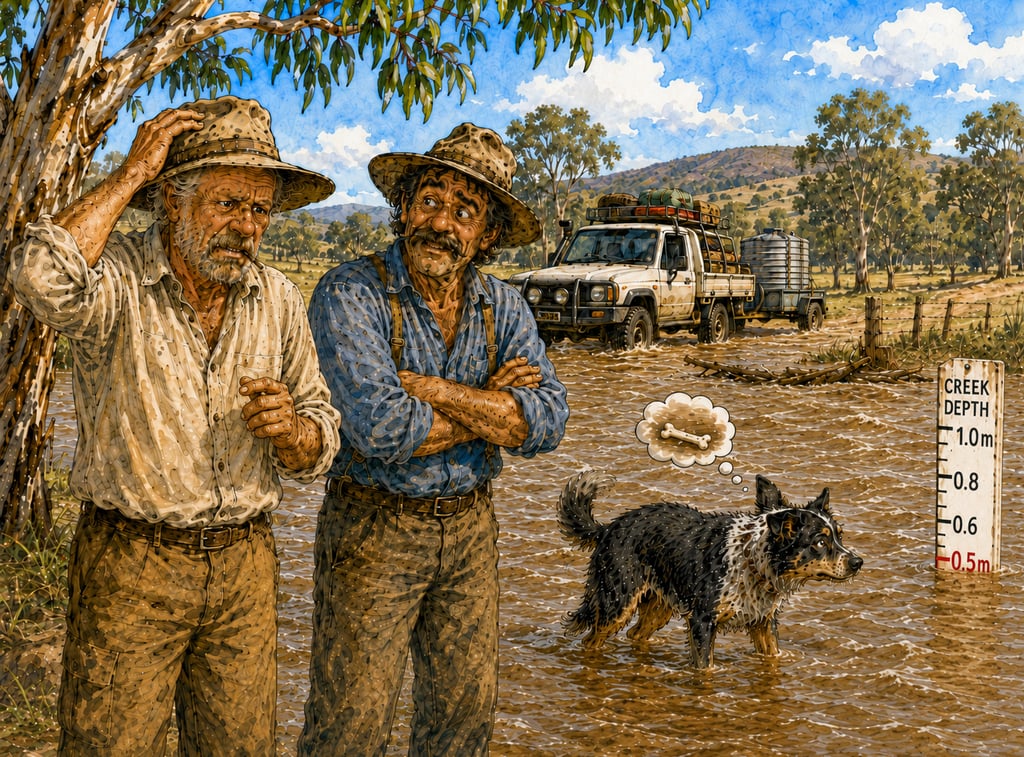
Bill had bought a water tank.
It had dents in three places, a patch over a fourth and rust around the outlet, but it was cheap, and Bill maintained that rust was only a problem once daylight showed through it.
The tank was on the far side of Barkers Creek.
The proper road was nearly seventy kilometres.
The creek crossing was twelve.
Bill preferred the creek.
Tom found him tying chains onto the trailer.
“What’s the creek doing?”
“Thirty centimetres at four o’clock.”
Bill held up his phone. The forecast said Fine. Beneath it, a blue line showed the creek reaching 0.30 metres that afternoon.
“The ute’s good for forty,” Bill said. “Ten centimetres to spare.”
Tom looked toward the hills, where clouds were building.
“What about those?”
“That’s not here.”
Dog came out from under the workbench carrying his bone.
It was a serious bone, buried and recovered often enough to resemble a length of old fence post.
He climbed into the ute with it.
At the crossing, the water was clear and twenty-two centimetres deep.
Bill pointed at the marker.
“There.”
Dog jumped out, carried his bone to the marker and placed it carefully on the concrete footing around the post. The footing sat perhaps thirty-five centimetres above the water.
Then he climbed back into the ute.
Bill stared at the bone.
“What’s he doing?”
“Allowing five centimetres,” Tom said.
“He’s a dog.”
“Yes.”
Bill drove across.
The tank was larger than advertised.
Its owner helped them roll it onto the trailer using two fence posts, a rope and a method he said had worked before. They tied it down with chains, rope and a faded orange strap Bill had found beside the highway.
The owner glanced toward the hills.
“Bit of rain up there.”
“Forecast says fine,” Bill said.
“They get storms through the top country.”
“It’s not raining here.”
“No,” said the owner.
On the way back, they found a branch across the road.
Then they found the creek.
Brown water pushed over the crossing carrying leaves, grass and small pieces of tree. The depth marker showed fifty centimetres.
Dog leapt out and ran to the post.
The bone was gone.
He looked downstream.
Then he looked at Bill.
Bill checked his phone.
The forecast still said Fine.
The creek prediction still said thirty centimetres.
He refreshed it.
Still thirty.
“That’s wrong.”
Tom looked at the water.
“It does seem deeper.”
“The model said thirty.”
“It did.”
“And the forecast said fine.”
“It is fine here.”
Bill looked at the blue sky, then at the brown water.
Dog began searching the downstream bank.
Bill opened the weather details.
Beneath the cheerful yellow sun was a note about possible afternoon storms over higher ground.
“That should be at the top.”
“Probably.”
The creek rose another centimetre.
Bill watched Dog return without the bone.
“He made a stupid decision.”
“He copied you.”
“I was using a model.”
“So was he. You said thirty. He put his bone at thirty-five.”
“The model was wrong.”
“Maybe.”
Bill looked at him.
“Maybe?”
“It may have calculated thirty perfectly well from the weather it was given.”
“But the creek’s fifty.”
“Yes.”
“Then what good was the answer?”
Tom looked at the ute, the tank and the water running over the crossing.
“It told you what the creek was expected to do.”
“That’s what I needed to know.”
“No. You needed to know whether it was safe to bet the ute on it.”
Bill said nothing.
Dog sat beside Tom, muddy and boneless.
Tom scratched him behind the ears.
“He only risked a bone.”
Bill looked at the loaded trailer.
“Lucky dog.”
Why Bill’s Decision Was Not What He Thought It Was
Bill thought he had made a simple decision.
The creek was predicted to reach 30 centimetres. His ute could cross 40 centimetres. That gave him a 10-centimetre safety margin. Dog used the same reasoning. Bill said the creek would reach 30 centimetres, so Dog, trusting Bill's model left his bone 35 centimetres above the water.
Both decisions looked sensible.
The problem was that Bill treated that one calculated answer as though it described everything the creek might reasonably do. The 30-centimetre prediction was one plausible answer produced from one selected set of conditions and assumptions. Other equally reasonable inputs or assumptions could have produced different answers.
The creek might have reached 25 centimetres.
It might have reached 30.
It might have reached 50.
Bill did not know where the reported 30-centimetre result sat among those possibilities. It might have been near the middle. It might have been lower than most other reasonable predictions. It might have been higher. The model result did not tell him. It also did not tell him the chance that the creek would exceed the ute’s 40-centimetre limit.
That was the information Bill actually needed.
The model answered:
Given these conditions, what depth is the creek expected to reach?
Bill’s decision required a different answer:
How likely is the creek to exceed 40 centimetres, and am I prepared to risk the ute, trailer and tank if it does?
The model answered the first question. Bill assumed it had answered the second.
That is the point of the yarn. Dog risked his bone using the single predicted number Bill gave him, without knowing how reliable that number was..
The connection to Glan Devon
The atmospheric modelling for Glan Devon also produces calculated numbers. Using selected emissions, weather data and modelling assumptions, it predicts pollutant concentrations at different locations. Those calculations may be performed correctly. The model may be suitable for answering the question it was given:
Under these selected conditions, what concentrations are calculated?
But that is not the whole planning question.
Council must decide something broader:
Is there enough evidence to conclude that the development can operate without unacceptable impacts across the range of conditions that may reasonably occur?
As with Bill’s creek prediction, the reported atmospheric model is one possible result produced from one selected representation of the system. Other reasonable inputs and assumptions could be used to represent the weather, local wind behaviour, emissions, operating states and model settings. Those choices could produce different plume positions and different pollutant concentrations.
Several of those alternatives might be equally plausible.
The current result does not show where it sits among them.
It may be close to the centre of the reasonable possibilities.
It may predict lower concentrations than most alternatives.
It may predict higher concentrations.
Simply using a standard model does not make its result an average or central estimate. This matters when the predicted concentrations are compared with air-quality limits. A result below a limit may look reassuring. But the decision-maker still needs to know whether most reasonable outcomes would also remain below the limit. If the reported model happens to sit near the lower end of the plausible results, other equally reasonable model outcomes may be higher. Some may cross the limit or affect different locations. If the reported result is near the upper end, it may be conservative.
One result cannot tell us which is the case.
This does not mean the calculation is wrong. It means the result must be used for the question it can answer. A single deterministic model run provides a conditional prediction. It does not automatically provide the likelihood of an adverse outcome, the range of plausible outcomes or confidence that the planning conclusion will remain valid under different reasonable conditions.
That is why the important planning test is not simply:
Did the selected model run produce concentrations below the limits?
It is:
Would the planning conclusion remain the same across the range of reasonably plausible conditions?
Where the answer remains the same, despite reasonable changes to the weather, emissions and modelling assumptions, the decision may be robust. Where reasonable alternatives change the plume position, the affected location or whether a limit is exceeded, one preferred result is not enough to settle the decision.
Bill had a predicted depth and a crossing limit.
What he did not have was a measure of the risk that the creek would exceed that limit.
The Glan Devon assessment has predicted concentrations and assessment limits.
The remaining question is whether it provides enough information about the other plausible outcomes—and the likelihood and consequences of those outcomes—to support the decision Council must make.
© 2026. All rights reserved.