Every Truck is Income
Making money from waste can come with a cost
Scott Dunham
6/24/20263 min read
Imagine you run a business.
Nothing fancy. You buy flat-pack furniture, assemble it, and sell the finished product.
Basically:
Stuff comes in → you do something → product goes out
Maybe it is IKEA wardrobes. You buy the flat packs, build them, and sell the finished wardrobes for a profit.
Simple enough.
To make more money, you have three choices.
Buy the flat packs cheaper.
Build them faster.
Sell the wardrobes for more.
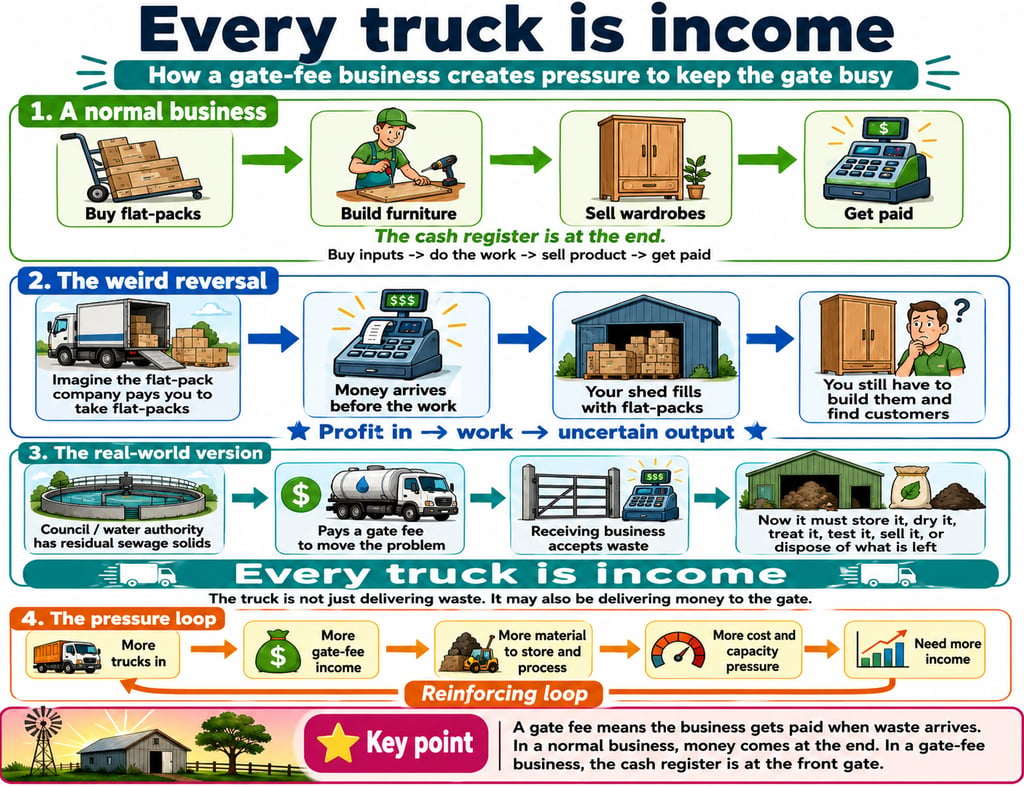
That is ordinary business. The cash register is at the end. You only get paid if someone wants the finished product.
Now imagine something strange.
IKEA starts paying you to take the flat packs.
That sounds wonderful. You have not even opened the little bag of screws and the money is already coming in.
The truck arrives.
The flat packs come off.
The cash register rings.
Beautiful.
Except now your shed is filling with flat packs.
You still have to build them. You still need workers, tools, space, storage and customers. And sooner or later you still need people who want to buy another beige wardrobe called Björkflappen or whatever.
So the business has changed.
It used to be:
Cost in → work → profit out
Now it is:
Profit in → work → uncertain output
That is a very different animal.
Now shift from IKEA to sewage. Sorry. Big shift. But that is where this gets real.
Every town has to deal with what goes down the toilet. We do not talk about it much, for obvious reasons, but the system never stops.
Toilets flush. Drains run. Wastewater treatment plants receive more material every day.
The water can be treated. Some material can be broken down. Some can be separated, dried, stirred, settled, dosed, skimmed and otherwise encouraged to behave itself.
But there is still leftover solid material.
And more keeps arriving.
For a council or water authority, that is a continuing problem. The material needs land, treatment, storage, transport, approvals, monitoring and money. It does not stop arriving just because everyone would rather talk about roads and rates.
So one option is to pay someone else to take it.
That is where the truck comes in.
From the outside, the truck is delivering waste.
From the receiving business’s side, the truck may also be delivering money.
Every truck through the gate can mean income. The material is accepted, the payment is made, and the receiving business now owns the problem.
The industry term for that payment is a gate fee.
It sounds dull. It is not.
A gate fee means the business is being paid when the waste arrives.
That matters because it puts the cash register at the front gate.
In a normal business, the business is pulled by the customer. You make more because people want to buy more.
In a gate-fee business, the business can be pushed by the input. You earn more by accepting more.
That is the structural pressure.
The front end is easy to understand:
Truck arrives → waste accepted → business gets paid
The back end is harder:
store it → dry it → treat it → blend it → test it → sell it → reuse it → dispose of what is left
Those two parts may not move at the same speed.
Trucks can keep arriving.
Gate fees can keep coming.
But storage can fill.
The plant can slow down.
Equipment can break.
Weather can interfere.
The output may not sell quickly enough.
The market may not want it.
The residues may still need somewhere to go.
Meanwhile, the bills keep arriving too: staff, machinery, loans, fuel, power, maintenance, transport, compliance and overheads.
So where does the business find more income?
At the gate.
More trucks mean more income.
More income helps cover more costs.
More material creates more need for storage and processing.
More storage and processing create more cost.
More cost creates more need for income.
And around it goes.
More waste in → more gate-fee income → more material to manage → more cost and capacity pressure → more need for income → more waste in
That is the loop.
This is why the words “gate fee” matter, even though they sound harmless.
The plain-English version is much clearer:
Every truck is income.
And when every truck is income, the system is under pressure to keep the trucks coming.
Join the conversation here
© 2026. All rights reserved.