Poo and the Ship of Theseus
Bill gets philosophical about... Poo
Scott Dunham
7/21/20264 min read
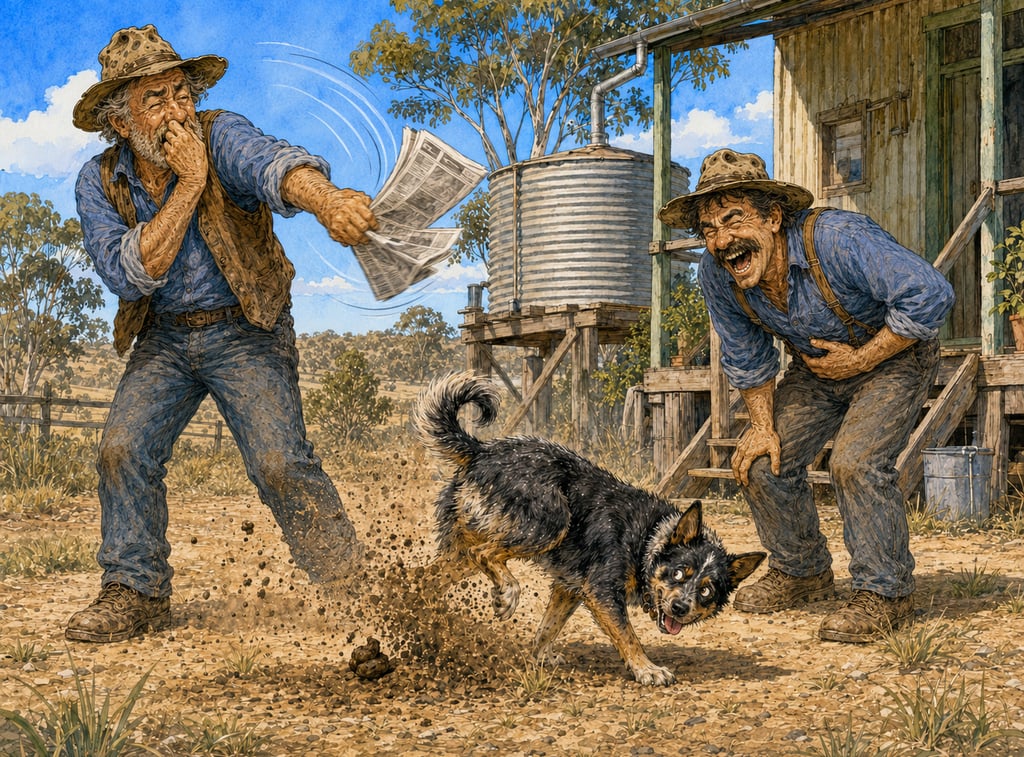
Bill was sitting on the back step reading the paper when Dog came out from underneath the house.
“Dog,” said Bill, “when is poo no longer poo?”
Dog stopped.
He had been asked some poor questions in his time, but this showed promise of being the worst.
Bill folded the paper.
“It says here biosolids aren’t poo.”
Dog sat down.
“They come from sewage,” Bill said. “But they’ve been treated.”
Dog scratched behind his ear.
“Then they dry them.”
Dog yawned.
“Then they mix them with fertiliser and make pellets.”
Dog looked towards the gate.
“That’s the question,” Bill said. “When does the change happen? Is it when they treat it? When they dry it? When they mix something else into it? Or when they make it into pellets?”
Tom came around the side of the house carrying a fencing bar.
“What are you doing?”
“Talking to Dog.”
“I can see that.”
“We’re discussing when poo ceases to be poo.”
Tom put down the bar.
“Why?”
“Council was told biosolids aren’t poo.”
“What are biosolids?”
“Stuff recovered from sewage.”
“So, poo.”
“No. Biosolids.”
“What’s the difference?”
“They’ve been processed.”
Tom considered this.
“If I leave a cow pat in the sun, it dries out.”
“Yes.”
“Is it still a cow pat?”
“Yes.”
“What if I break it up?”
“Still a cow pat.”
“What if I mix something with it?”
“Depends what you mix with it.”
“How much do I have to mix with it before it stops being a cow pat?”
Bill looked at the paper.
“It doesn’t say.”
“What if I make it into pellets?”
“That’s different.”
“Why?”
“It looks like fertiliser.”
“So it stops being poo when it looks like something else?”
“I didn’t say that.”
“You nearly did.”
Dog stood up and walked into the yard.
He found a suitable place, turned around twice and relieved himself.
Then he scratched a little dust over the result and came back to the step.
Bill looked at Tom.
“There you are. Dog has processed it.”
“Not much of a process.”
“It has been covered with another material. You could call it blending.”
Dog lay down.
A blowfly came over the fence, circled once and landed on the small patch of disturbed earth.
Tom picked up his fencing bar.
“Seems the independent assessor isn’t convinced.”
Bill looked at the fly.
The fly had not read the paper.
Heaps, ships and poo
The joke in Bill and Tom’s conversation is that Bill reaches for Greek philosophy while Tom calls a spade a spade.
The sorites paradox asks when a collection of grains becomes a heap. After all, we'd all agree one grain is not a heap. Two grains are not a heap. Keep adding grains and eventually everyone agrees there is a heap—but nobody can identify the particular grain that made the difference. Was it after grain 10, 100, 1000?
Glan Devon raises much the same question.
Wet biosolids arrive from sewage treatment plants. They are dried, mixed with mineral fertiliser and made into pellets. At which step do the biosolids stop being regulated waste and become a fertiliser resource? Does removing water change their identity? Does adding another material? Does changing their shape and giving the finished mixture a new name?
The Ship of Theseus asks a similar question from another direction. If a ship’s planks are replaced one at a time, does it remain the same ship? At Glan Devon, the appearance and handling qualities of the material change, but many of its original constituents remain.
Drying removes water. It does not automatically remove metals, PFAS or other contaminants. Mixing the dried material with fertiliser may reduce their concentration in each kilogram of product, but it does not make them disappear. The material may look different while still carrying much of what entered the process.
That is why saying “biosolids are not poo” is a bit disingenuous. The smell is still there, the risk of pathogens is not entirely removed and calling it 'bacteria bodies' conveniently ignores a lot of other components.
Technically, biosolids are not simply raw poo. They are treated solids produced from sewage, and “poo” is neither a scientific nor a legal classification. But that distinction avoids the question people are really asking.
The important question is whether the material remains regulated waste and what must be demonstrated before it can be treated as a resource.
Processing and renaming waste do not automatically change its legal identity. That happens only when the material meets the requirements of an applicable End of Waste Code or approval. In other words, the boundary is crossed by evidence and compliance—not by drying, blending or pelletising.
Then there is the particularly tricksy word “unrestricted”.
To most people, “unrestricted agricultural use” sounds as though the product can be used anywhere and in much the same way as ordinary fertiliser.
Within the Biosolids Code, however, “unrestricted use” is the name of a quality classification. The material must first meet the required contaminant, stabilisation and pathogen standards. Testing, monitoring, recordkeeping, approved uses and other conditions still apply.
So “unrestricted” does not mean unrestricted in the ordinary sense. It means fewer restrictions within an already regulated system.
Bill’s question is therefore the right one: when does poo stop being poo?
Tom’s answer would probably be simpler.
It stops being regulated waste when you prove that it meets the rules—not when you dry it, put it into pellets or call it something nicer.
© 2026. All rights reserved.