The Ant Trail and the Three-Millimetre Hole
Running a processing plant is not as easy as it sounds. And that ahas consequences
Scott Dunham
7/3/20269 min read
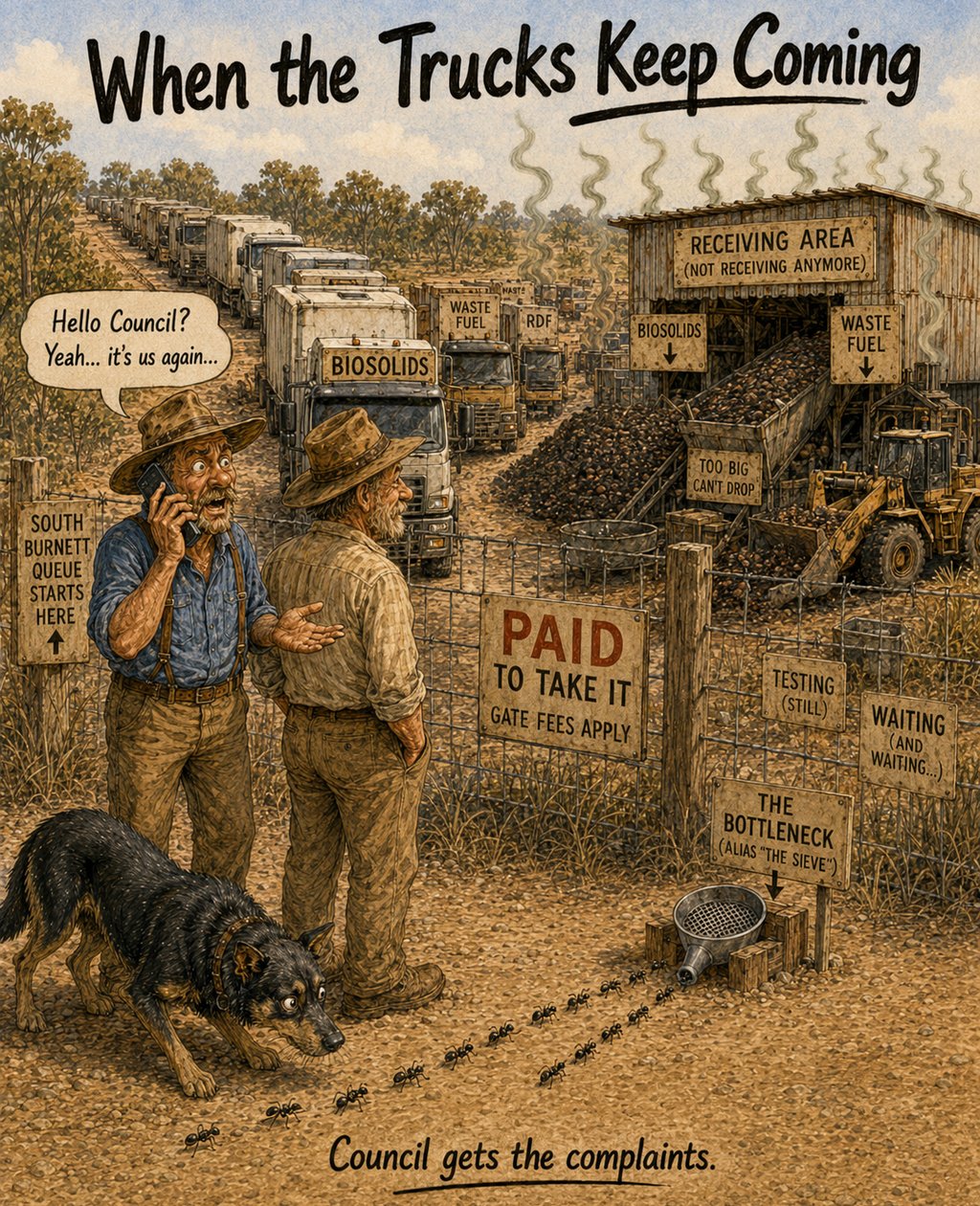
Bill was leaning on the fence, watching a line of ants carry bits of dead beetle across the dust.
Tom had come over to borrow a spanner.
That was how it usually started. Tom came for a tool. Bill gave him a lesson. The tool appeared later, sometimes.
Bill pointed at the ants.
“Look at that, Tom.”
Tom squinted. “Ants.”
“No,” said Bill. “A materials handling system.”
Tom shut his eyes for a moment.
“I only came for a half-inch spanner.”
“You’ll get it,” said Bill. “After the ants.”
The ants were travelling in a neat little line from the old tank stand to a dead beetle near the shed. Some carried big pieces. Some carried tiny crumbs. Some had nothing at all and seemed to be supervising.
Bill nodded toward them.
“That’s what people imagine when they read a project report. Material comes in. Material gets processed. Product goes out. Nice steady line. Tonnes per year. Tonnes per day. All very tidy.”
Tom said, “Looks tidy enough.”
“For now,” said Bill.
He picked up a twig and laid it across the ant trail.
The first ants stopped. The ants behind ran into them. Some tried to climb over. Some went around. Some turned back. Within seconds, the neat line became a little traffic jam.
Bill smiled.
“There’s your first constraint.”
“You blocked the track.”
“No,” said Bill. “I reduced the capacity of one part of the system. Same thing.”
The ants began to bunch up.
“That is what happens when flow meets a bottleneck. Doesn’t matter if the average looks good. If material arrives faster than the narrowest part can handle it, you get a queue.”
Tom looked at the ants.
“So this is the truck queue.”
“Partly,” said Bill. “But trucks are only the first ant trail.”
Tom frowned. “There’s more than one?”
“There’s always more than one.”
Bill walked to the shed and came back with two old kitchen sieves, one coarse and one fine. He set them on an upturned bucket.
“Imagine this beetle is biosolids,” he said. “And imagine that pile of dry grass over there is waste fuel.”
“That’s a bit rough on the beetle.”
“The beetle’s past caring.”
Bill dropped a few beetle crumbs through the coarse sieve. Some fell through. Some stayed on top.
“Some industrial systems don’t just need material. They need material in the right form. Right moisture. Right size. Right composition. Not too wet. Not too lumpy. Not too contaminated.”
Tom watched the larger pieces sit there.
“So you crush it.”
“You might,” said Bill. “Or screen it. Or dry it. Or blend it. Or reject it. But every one of those steps is another place the system can slow down.”
Bill pointed back at the ants.
“Now imagine the ants have two jobs. One group brings beetle. One group brings dry grass. The beetle is the biosolids stream. The grass is the fuel stream. Both have to arrive. Both have to be stored. Both have to be prepared. Both have to feed the same process.”
Tom looked at him.
“You’ve made ants complicated.”
“No,” said Bill. “The ants were always complicated. I’m just pointing it out.”
Bill picked up a long grass stem and dropped it onto the fine sieve. It sat there uselessly.
“Now here’s the waste fuel stream. They might call it fuel, not waste. That sounds tidy. But calling it fuel does not make the handling problem disappear.”
“Why not?”
“Because the machine does not run on words,” said Bill. “It runs on material.”
He held up the sieve.
“If the fuel has to be at least sixteen megajoules per kilogram, no more than twenty percent moisture, and no larger than three millimetres, then it is not enough to say, ‘We have waste fuel.’ The real question is whether they can reliably turn variable waste into fuel that is dry enough, energetic enough and small enough.”
Tom looked at the grass stem.
“Three millimetres is not much.”
“No,” said Bill. “You can call a log a matchstick if you like, Tom, but it still won’t fit through a three-millimetre hole.”
Tom smiled.
Bill shook the sieve. A little dust fell through. The bigger pieces stayed where they were.
“That,” said Bill, “is what annual tonnage can hide.”
Tom looked at the mess in the sieve.
“Average tonnes don’t tell you whether the material fits through the holes.”
“Exactly. A report can say the system handles so many tonnes per year. But the plant does not process averages. It processes actual loads, on actual days, with actual moisture, actual particle size, actual contaminants, actual fuel value, actual weather and actual machinery.”
Bill tipped a mix of beetle crumbs and grass stems onto the fine sieve.
“Some material will be too wet. Some will be too coarse. Some may not have enough energy. Some may need sorting. Some may need crushing. Some may need testing. Some may be rejected. Some may sit there waiting for the next step.”
Tom said, “So the fuel stream has its own bottlenecks.”
“Yes. Acceptance, sorting, crushing, screening, moisture, energy value, storage, emissions and feeding the thermal unit.”
“And the biosolids have moisture, smell, particle size, contaminants, testing, drying, storage and product quality.”
“Correct.”
“So there are two messy streams feeding one plant.”
Bill smiled. “Now you’re seeing it.”
He shook the sieve again. The fine dust fell through. The larger pieces bounced around uselessly on top.
“If the biosolids are ready but the fuel is wrong, the plant is constrained. If the fuel is ready but the biosolids are too wet or waiting on test results, the plant is constrained. If the crusher blocks, the fuel stream is constrained. If the dryer slows, the biosolids stream is constrained. If emissions control becomes the limit, both streams are constrained. If product dispatch slows, the back end fills and the front end feels it.”
Tom looked back at the ants.
“So the bottleneck can move.”
“It usually does,” said Bill. “One day it’s the dryer. Another day it’s the crusher. Another day it’s the screen. Another day it’s storage. Another day it’s testing. Another day it’s product demand. Another day it’s the weather.”
He paused.
“And another day it’s complaints.”
Tom said, “Complaints can be a bottleneck?”
“They can become a constraint. If odour complaints force investigation, if stockpiles need reducing, if truck movements need managing, if a regulator starts asking questions, then the system is no longer just constrained by machinery. It is constrained by permission, confidence and patience.”
The ants had found a way around the twig by now, but the trail was still ragged. Some ants were stuck at the old blockage even though the path had partly reopened.
Bill pointed.
“That’s another thing. Once a queue forms, it doesn’t vanish just because the bottleneck improves. The backlog still has to be worked through.”
Tom nodded.
“So if the dryer slows, or the crusher blocks, or the screen clogs, or testing takes longer, or fuel quality changes, material backs up.”
“Correct.”
“When a system is run close to full capacity,” said Bill, “variability creates queues. Not as a rare surprise. As a normal feature of the system.”
Tom scratched his chin.
“So for Glan Devon, it is not enough to ask how many tonnes per year.”
“No,” said Bill. “You have to ask what form those tonnes are in, how variable they are, and what happens when they don’t fit the process.”
Tom was quiet for a while.
Then he said, “And the trucks might still keep coming.”
Bill gave him a flat look.
“That’s where the money comes in.”
“Gate fees.”
“Exactly. If the business is paid when material comes through the gate, each truck is like the cash register ringing. So the front gate is not just logistics. It is revenue.”
Tom looked down at the ants.
“So even if the sieve is blocked, there may be pressure to keep accepting beetle.”
“Correct.”
“And grass.”
“Correct again.”
“And if they keep accepting both streams, but one of the preparation steps is constrained, the material has to go somewhere.”
Bill nodded.
“Storage. Temporary storage. Emergency storage. Material awaiting processing. Material awaiting testing. Material awaiting blending. Material awaiting dispatch. Every word sounds reasonable by itself. But the pile still grows.”
Tom said, “And then the neighbours smell it.”
“Maybe. Or they hear it. Or they see more trucks. Or stormwater becomes harder to manage. Or dust becomes an issue. Or the operator says the problem is temporary and under control.”
“And council gets called.”
“Council always gets called,” said Bill. “Because council approved the land use.”
Tom leaned against the fence.
“But if it’s a private business, why does that cost council?”
Bill laughed once.
“Because complaints are not handled by magic.”
He held up one finger.
“Someone has to take the complaint. Someone has to log it. Someone has to decide whether it is planning, environmental health, roads, compliance, waste, amenity, the state, or some awkward mix of the lot.”
He held up another finger.
“Then someone has to inspect, request records, check conditions, talk to the operator, talk to the complainant, review monitoring data, write file notes, prepare reports and explain to councillors why everyone is angry.”
Another finger.
“Then the operator may say the issue is temporary, or weather-related, or already being managed, or within approval, or under another agency’s responsibility.”
Tom frowned.
“So the cost is staff time.”
“Staff time is money,” said Bill. “So are consultants. So are lawyers. So are extra inspections. So are community meetings. So are reports. So is dealing with angry ratepayers who think council approved the problem and then vanished.”
Tom said, “And the business keeps earning money?”
“Maybe,” said Bill. “That depends on the business. But here’s the uncomfortable bit. The private operator may collect the gate fee, while council collects the complaints.”
Tom looked at him.
Bill nodded.
“That is the cost transfer.”
He pointed back at the ants.
“If the ants make a mess in their own nest, that is their problem. But if council approves the ant trail across the kitchen table, then everyone in the house starts yelling at council.”
Tom smiled despite himself.
Bill kept going.
“And the cost is not just dollars. Residents lose trust. Councillors get pressure. Council officers get stuck in the middle. State agencies may say one part is their job and another part is council’s job. The operator says it is complying. The residents say they can smell it. The paperwork says one thing. The lived experience says another.”
Tom said, “So council ends up managing the operator’s bottleneck.”
“Exactly,” said Bill. “That is the danger. A loosely bounded approval does not remove risk. It can move risk from the applicant’s design stage to council’s enforcement stage.”
Tom was quiet.
Bill tapped the sieve again.
“That is why performance-based design worries me when the operating limits aren’t nailed down. It can sound flexible and modern. But if the approval doesn’t say where the hard stops are, the argument happens later.”
“After the complaints?”
“Usually. And by then everyone is arguing about whether the stockpile is temporary, whether the smell is proven, whether the trucks are within expectation, whether the material is waste or product, whether the fuel is really fuel, and whether the problem belongs to council, the state, the operator, or nobody in particular.”
Tom grimaced.
“That sounds like a mess.”
“It is,” said Bill. “And ratepayers pay for messes. Maybe not with one big invoice labelled ‘biosolids plant problem’. More likely through officer time, diverted attention, consultants, legal advice, extra meetings, inspections, complaint systems and political damage.”
Tom looked at the ants again. They had restored their trail, but the area around the twig was still churned up.
“So council should ask the hard questions before approval.”
“Yes,” said Bill. “Before. Not after.”
He counted again.
“How many tonnes can arrive in a day? How much biosolids can be stored? How much waste fuel can be stored? How long can each stay on site? What particle size is acceptable? What moisture is acceptable? What minimum fuel value is required? What happens when the crusher is down? What happens when the dryer is down? What happens when the screen blocks? What happens in wet weather? What happens during odour complaints? Who has authority to shut the gate? Who pays for independent monitoring? Who pays if repeated problems create extra council compliance work?”
Tom said, “Can council make them pay for that?”
Bill shrugged.
“That is a legal and planning question. But council should at least ask it. Because if the answer is not clear, there is a fair chance the cost lands back on council and ratepayers.”
Tom nodded slowly.
“So the lesson is not just don’t block the ant trail.”
“No,” said Bill.
“The lesson is don’t approve the ant trail unless you know what happens when the trail blocks, the sieve clogs, the crumbs are too big, the grass is too wet, the fuel is too weak, both mobs of ants keep arriving, and the people in the house start complaining.”
Bill smiled.
“Now you’re ready.”
“For the spanner?”
“For the spanner.”
Tom waited.
Bill looked around the shed.
“On average,” he said, “I know exactly where it is.”
Join the conversation here:
Here's what Bill is really saying
The point of the story is simple: the Glan Devon proposal should not be assessed only on annual tonnes. Real industrial systems deal with variable material, wet weather, equipment limits, storage limits, testing delays, odour risk and market demand. When those pressures hit a bottleneck, queues and stockpiles can build quickly.
If the business earns money when material comes through the gate, there may be pressure to keep accepting loads even when the system is constrained. That is why council needs clear hard limits before any approval: maximum receival, maximum storage, feedstock specifications, stop-receival triggers, outage rules, odour controls, monitoring, and who pays for enforcement if problems arise.
A loosely bounded approval does not remove risk. It can shift the risk (and the cost) from the applicant to council, residents and ratepayers.
© 2026. All rights reserved.