The Bloke Who Always Said Yes
6/28/20265 min read
The Bloke Who Always Said Yes
Bill reckoned every district had one.
A bloke who could look at any idea, no matter how cockeyed, and find a way to say yes.
Not a fool. Not a crook. Often a clever sort of bloke. The sort who owned a good tape measure, wore clean boots, and could draw a straight line on the back of a fuel docket while holding a pie in the other hand.
Bill had known one years ago.
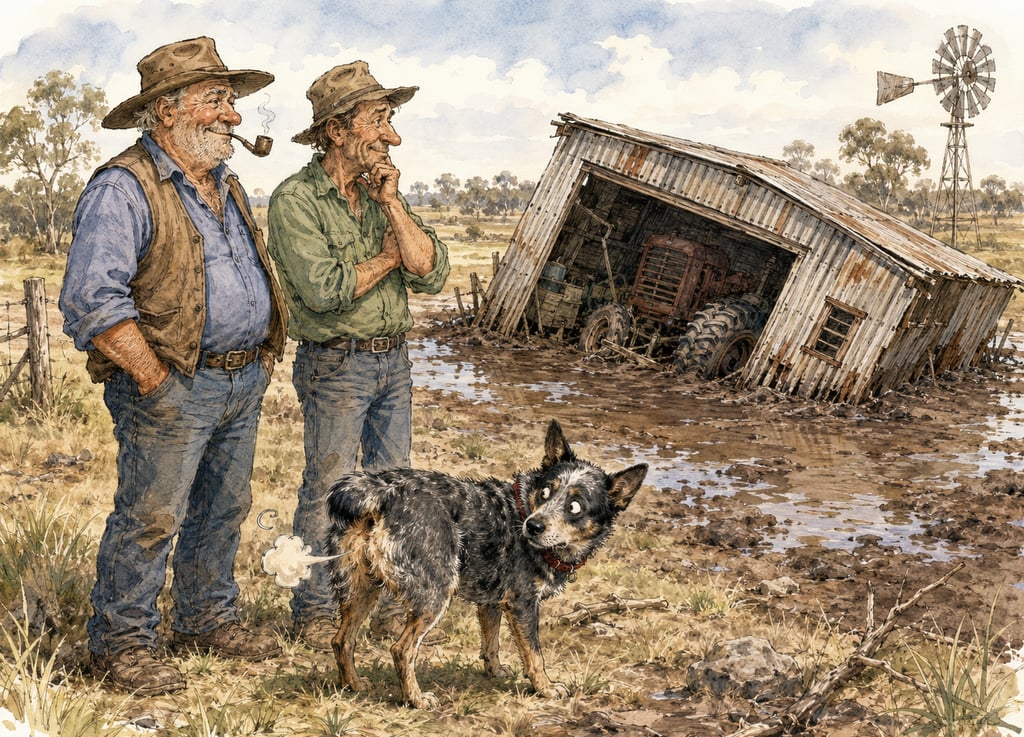
A farmer down the road wanted to build a machinery shed on a patch of ground that turned to soup every time it rained. Everyone in the district knew it was a bad spot for a shed. The old people knew it. The postie knew it. Even the cattle walked around it.
But the farmer wanted the shed there because it was close to the gate.
So he got a bloke out to have a look.
The bloke walked around the wet patch, pushed his boot into the mud, scratched his chin and said, “Yes, you could build it here.”
Bill, who had wandered over for no particular reason except that he had noticed a ute and didn’t trust unexplained utes, leaned on the fence.
“Could,” he said.
The bloke nodded. “You’d need extra gravel. Bigger footings. Maybe some drains. Bit of geotech. Probably cost a fair bit more.”
“But you could do it?”
“Oh yes,” said the bloke. “You could do it.”
The farmer smiled, because that was the answer he wanted.
Bill spat into the grass.
Tom heard the story later, sitting under the pepperina tree with a mug of tea and the dog stretched out between them, chasing rabbits in his sleep.
“So the bloke was wrong?” Tom asked.
“No,” Bill said. “That’s the trouble. He was probably right.”
Tom looked over his glasses.
Bill took a slow sip of tea.
“He answered the question he was asked.”
“Which was?”
“Can we build the shed there?”
“And the answer was yes?”
“Likely enough. If you spend enough money, dig enough drains, cart in enough gravel and pretend the mud isn’t trying to tell you something.”
Tom nodded.
“But that wasn’t the question that mattered,” Bill said.
The dog woke at the sound of Bill’s voice, decided no food was involved, and went back to sleep.
“The question that mattered was whether any sensible person would put the shed there in the first place.”
Tom smiled.
Bill pointed with his mug towards the hills.
“That’s the thing with feasibility studies. Most of ’em start with someone wanting the answer to be yes. They don’t always ask, ‘Is this the best idea?’ They ask, ‘How do we make this idea work?’”
“And once you ask it that way,” Tom said, “you’re already halfway there.”
“More than halfway,” Bill said. “Because every problem becomes something to manage. Bad ground? Add gravel. Bad access? Add trucks. Bad neighbours? Add a buffer. Bad smell? Add a management plan. Bad economics? Add a model.”
Tom laughed quietly.
Bill did not.
“I’m not saying they’re lying,” Bill said. “That’s too easy. Mostly they’re doing exactly what they were asked to do. They find a path through. They write down the path. They make the thing look possible.”
He paused.
“But possible isn’t the same as wise.”
Tom looked across the paddock, where the afternoon light had caught on the tin roof of Bill’s shed.
Bill went on.
“A development application is a bit like that bloke at the wet paddock. It might have real measurements in it. Real drawings. Real numbers. Real experts. But the whole thing is still built around a yes.”
Tom nodded.
“So the reader has to remember who asked the question.”
“And what question they asked,” Bill said.
The dog sat up, farted, then spun around and stared at his own backside as if someone else must have done it.
Bill glanced down.
“There you go,” he said. “Even he can produce something real. Doesn’t mean it improves the district.”
Tom nearly lost his tea.
Bill leaned back in his chair.
“That’s why I get wary when people wave a report around like it came down from the mountain on a stone tablet. A report can be honest and still be narrow. It can answer a technical question and still miss the public one.”
“Which is?”
Bill looked towards the road.
“Not ‘Can they make it work?’”
He set his mug down.
“‘Should we be asked to live with it if they can’t?’”
Join the conversatioh
Reading an applicant’s DA with the right frame of mind
While the story is amusing (Like Tom I nearly spat my tea when I read about the dog fart!) it shows a real problem. It's a problem with the way our minds work and interpret things. Here's a clearer explanation.
One thing I learned a long time ago is that people running feasibility studies are usually incentivised to make the project work, not make it fail. They get paid to find an answer that works, to say 'yes'.
That does not mean they are dishonest. It does not mean the numbers are invented. It does not mean the consultants are fools. But it does mean the whole process tends to lean in one direction.
The question becomes: how can this project be made to work?
Not: should this project exist here?
Not: what would an independent reviewer worry about first?
Not: what are the strongest reasons to reject it?
That matters when reading a development application.
A DA is not a neutral public-interest inquiry. It is an applicant’s case for approval. It may contain expert reports, professional modelling, engineering concepts, environmental assessments and economic estimates. Some of that work may be technically competent. Some of it may be useful. But the overall document is still advocacy. It is trying to persuade the decision-maker that the proposal is acceptable.
It's selling something.
The risk is that our minds do not always treat it that way.
When we see formal reports, consultant logos, tables, maps, model outputs and dollar figures, we tend to give them the feel of independent truth. We respond to authority. We anchor on the first numbers we see. We accept the frame we are given. We notice what is written down more easily than what has been left out.
And that is where the danger sits.
The problem is often not a lie. It is a narrowing of the question.
A report can answer a small question accurately while leaving the larger public question unanswered. It can show that a control exists without proving the system will operate reliably. It can show that a project creates activity without proving the region is better off. It can show a dollar value without proving a net gain.
That is the point to keep in mind before looking at the economic modelling.
The issue is not whether the model contains real numbers. The issue is whether the model is answering the question people think it is answering.
An input-output model (like the one used in the Glan Devon Biosolids DA) may count money moving through a project. It may estimate spending, jobs, wages, purchases and flow-on activity. Those may be real figures. But real activity is not the same thing as a larger regional pie. Some of that money may be displaced from elsewhere. Some costs may be shifted onto the community. Some risks may sit outside the model altogether.
So before accepting the economic argument, we need to ask a simpler question:
Is this measuring a genuine net benefit, or is it mostly counting the money that washes through the project?
Because a number can be real, a model can be real, and the conclusion can still be much weaker than it first appears.
Join the conversation
© 2026. All rights reserved.