The Fence Around Uncertainty
Two blokes, a yarn and uncertain outcomes
Scott Dunham
6/26/20267 min read
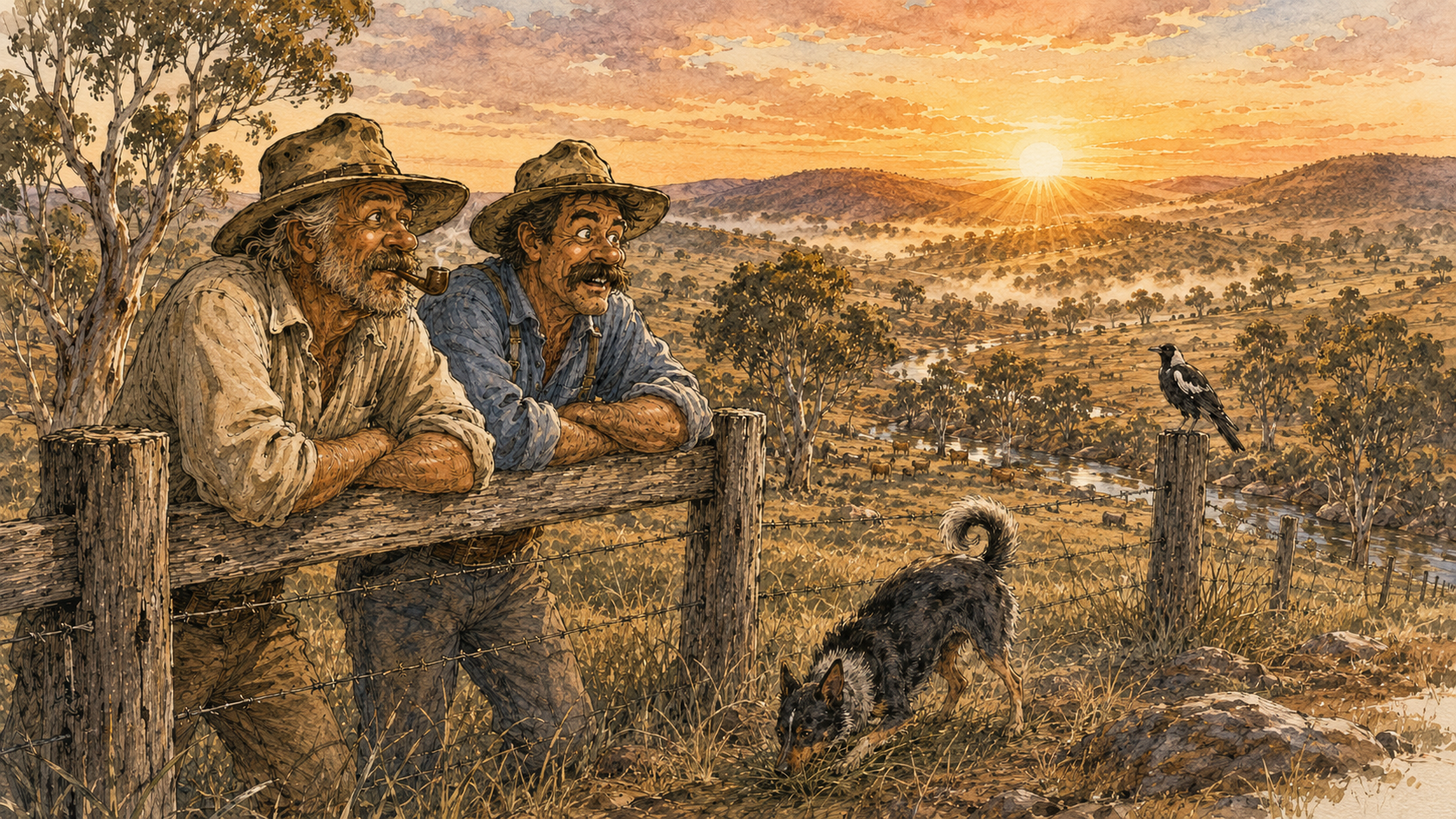
Some risks are managed before approval. Others are handed to the community.
Bill and Tom were standing on the ridge at first light, watching the sun come up over Glan Devon.
It was the sort of morning that made even old fence posts look respectable. The paddocks lay quiet below them, pale and silver in the low light. A line of gums followed the creek like someone had drawn it there with a careful hand. Far off, a magpie began his morning argument with the universe, and a few cattle stood about looking as if they had been appointed to a committee but had not yet received the papers.
Tom had a mug of tea in one hand and both elbows on the fence.
“Hard country to dislike,” he said.
Bill grunted.
Tom waited. Bill’s grunts came in several varieties, and this one had paperwork in it.
At last Bill said, “Country like this can look safe just because it’s quiet.”
Tom looked across the paddocks again.
“Safe from what?”
“From bad ideas,” said Bill.
Tom sighed. “You’re talking about that biosolids plant.”
“I am.”
“It’s meant to be a fertiliser plant.”
“That’s what they’d like people to hear first,” said Bill. “Fertiliser sounds useful. Waste treatment sounds like something you put somewhere else.”
Tom took a slow drink.
“And you reckon it’s the second one?”
“I reckon if a thing needs truckloads of biosolids and non-recyclable waste coming in, thermal processing, odour control, emissions control, residues, wastewater management, stockpile limits, product testing, environmental approvals and a change in land use, then a man should not be too quick to call it a farm shed.”
Tom gave that some thought.
Down below them, the creek line sat in the dawn shadow. It looked harmless enough. Creeks often do when they are not being asked to carry someone else’s mistake.
Bill pointed with his mug.
“See that?”
“The creek?”
“Aye. And where does water go when it has had enough of being here?”
“Downstream.”
“And what’s downstream?”
Tom looked toward the low country.
“Bjelke-Petersen Dam.”
Bill nodded. “BP Dam. Water storage. Recreation. Fishing. People camp there. People care about it. Now, I’m not saying this plant will pollute it. I’m saying if you’re choosing where to put an uncertain industrial process, near creeks that head toward a dam is a strange place to start.”
Tom frowned.
“That sounds a bit blunt.”
“Good,” said Bill. “Some things improve when they’re blunt.”
The old dog wandered up, sniffed Tom’s boot, decided there was no evidence of breakfast, and lay down in the grass.
Tom said, “But they must have picked the site for a reason.”
Bill gave him a look.
“Being able to buy a block is not a planning reason.”
“No.”
“Being able to buy it cheap is even less of one.”
Tom rubbed his chin. “We don’t know that’s why.”
“No,” said Bill. “So don’t say it as fact. Say this: if the best argument for Glan Devon is that a rural block was available, affordable, or convenient for the applicant, that is not enough. The question is not whether the applicant could get the land. The question is whether the land should carry the risk.”
Tom looked over the country again. The light was stronger now. The paddocks had lost their silver edge and become ordinary useful land.
Bill said, “Ten years from now, this place can go two ways.”
Tom smiled faintly. “Here we go.”
“No, listen. First way: people keep thinking of this district as country worth visiting. Farms. clean produce. markets. birdlife. farm stays. caravaners. weekend drives. fishing at BP Dam. families stopping in Nanango and Kingaroy because the place feels like somewhere, not just a gap between other places.”
“That’d be nice.”
“It would be more than nice,” said Bill. “It’d be sensible. Rural places have to build on what they are. Good land, clean water, open space, local food, recreation, tourism, wildlife, quiet roads, and the sort of reputation people trust without needing a lab report.”
Tom looked at him. “And the second way?”
Bill turned and looked down toward the highway.
“Second way, the district gets known for waste.”
Tom said nothing.
“Not farming. Not tourism. Not recreation. Waste. Trucks coming in. People asking what’s in them. People asking what’s being burned, dried, blended, stored or spread. People asking what the smell is. People asking whether produce from nearby land is still clean. People asking whether crops are organic anymore, or whether they can be marketed the same way. People asking whether the creek is safe after storms. People asking whether Council knows what it approved.”
The magpie stopped singing. Even the dog opened one eye.
Tom said, “Like Luggage Point?”
Bill nodded slowly.
“Luggage Point may do its job. Brisbane needs places like that. But no one hears Luggage Point and thinks boutique farm produce, weekend cottages and sunrise bird walks.”
“No,” said Tom. “They think treatment works.”
“Exactly. Some places get a name attached to them. Once it sticks, it doesn’t come off just because someone waves a certificate.”
Tom looked uneasy.
“But surely if everything is tested and compliant—”
Bill cut him off.
“That word ‘if’ is doing a lot of unpaid labour.”
Tom shut his mouth.
Bill went on.
“If the feedstock is always exactly what they say. If the technology works every day. If the odour controls work in real weather. If the emissions are properly measured. If residues are handled correctly. If stormwater is contained. If the product always meets specification. If the fertiliser market takes the output. If trucks don’t queue. If stockpiles don’t grow. If Council can enforce every promise. If complaints are investigated quickly. If expansion pressure doesn’t arrive later wearing a clean shirt and calling itself Stage Two.”
Tom stared at the sunrise, which had suddenly become less comforting.
“That’s a lot of ifs.”
“Aye,” said Bill. “And they’re not the sort of ifs you put on a rural block and hope for the best.”
The dog stood, stretched, and trotted toward a patch of grass with the enthusiasm of a creature that had found a simpler problem.
Tom said, “So where should a thing like that go?”
Bill shrugged.
“Somewhere suited to the risk. Proper industrial land. Better separation. Better transport logic. Less reputational damage to farms. Less risk to creeks. Less chance that a rural community becomes the buffer zone for an experiment.”
“They call it a trial, don’t they?”
“All the more reason to contain it,” said Bill. “A trial belongs inside a fence built for failure, not just success.”
Tom liked that phrase but did not say so. Bill got difficult when encouraged.
Bill leaned against the fence.
“People get this backwards. They say, ‘Don’t worry, it’s only a trial.’ But that’s exactly when you worry. A proven process has operating history. A trial has questions. A proven site has evidence. A trial site has assumptions. A proven business has known limits. A trial business has hope dressed as a schedule.”
Tom looked at him.
“That’ll upset people.”
“Only the ones who prefer fog.”
They stood quietly for a moment.
A ute passed on the road below, heading toward town. It looked small in the distance, just a moving glint in the sun.
Tom said, “What happens if Council approves it and it goes wrong?”
Bill laughed without much humour.
“Then everyone discovers how expensive uncertainty is.”
“Meaning?”
“Meaning complaints. Monitoring. Consultants. Lawyers. Council officers spending time on a problem they didn’t need to inherit. Councillors getting blamed by both sides. Departments shifting responsibility like a hot shovel. Conditions being argued over. Enforcement notices. Appeals. Maybe the Planning and Environment Court. Maybe other proceedings if environmental harm is alleged. And through all of that, ratepayers paying for the privilege of being told it’s complicated.”
Tom winced.
“Rates again.”
“Rates, time, trust and reputation,” said Bill. “Four things a small district cannot afford to waste.”
Tom looked down at the creek.
“And if there’s a spill?”
Bill did not answer straight away.
“That’s the thing,” he said at last. “You don’t assess a proposal like this by asking what happens on its best day. Any fool can make a thing look good on its best day. You ask what happens on its wettest day. Its hottest day. Its windiest day. Its broken-down day. Its truck-delayed day. Its market-collapsed day. Its ‘we just need temporary extra storage’ day.”
Tom nodded slowly.
“Because those days come.”
“They always come,” said Bill. “The only question is whether the approval was written by someone who expected them.”
The sun was properly up now. The mist was thinning. The country below them looked open and generous, which is sometimes why people ask too much of it.
Tom said, “I suppose some will say you’re against recycling.”
Bill snorted.
“That’s a child’s argument wearing its father’s boots. This isn’t about being against recycling. It isn’t about being against fertiliser. It isn’t about pretending biosolids don’t exist. It’s about whether this specific plant, with these uncertainties, belongs on that specific rural site.”
Tom repeated it slowly. “Specific plant. Specific uncertainties. Specific site.”
“Aye,” said Bill. “That’s the whole argument.”
“And if they can’t answer the questions?”
“Then they haven’t earned the approval.”
Tom looked across the valley one more time.
“It still seems strange,” he said. “Changing rural land use for something that might change the whole reputation of the place.”
Bill picked up his mug from the fence post.
“That’s because it is strange.”
He began walking back toward the ute, then stopped.
“Tom, there’s a rule with gates.”
“What rule?”
“Don’t open one unless you know what’s on the other side.”
Tom smiled. “That’s it?”
“No. That’s the small version.”
“And the big version?”
Bill looked back over the paddocks, the creek, the road and the country waking under the sun.
“The big version is this: when a decision can’t be easily reversed, uncertainty has to be contained before approval, not explained afterward. You don’t put an uncertain industrial plant on a rural block, near creeks running toward a public dam, and hope the fine print saves you. You define the risk, fence the risk, prove the process, pick the right site, and make the people who profit from the risk carry it.”
Tom nodded.
“And if they don’t?”
Bill opened the ute door.
“Then the community becomes the experiment.”
The dog jumped onto the back of the ute and sat there looking pleased with himself, as dogs often do when they have contributed nothing but still expect credit.
Tom climbed in beside Bill.
As they drove down the track, the sun rose higher over Glan Devon, shining on paddocks, fences, creek lines and roofs.
For now, it still looked like country.
Bill hoped people understood that was not guaranteed.
Join the conversation
© 2026. All rights reserved.