The firewood drier and the veggie patch
Why is the firewood drier in the veggie patch? Because Tom owns the veggie patch and doesn't own the block near the woodshed. The planning scheme doesn't care.
Scott Dunham
7/21/20264 min read
Tom came round one morning with a rolled-up plan under his arm and the look of a man who had already spent the money.
“What’s that?” Bill asked.
“A firewood-drying machine.”
Bill looked at the stack beside the shed.
The wood had been split, stacked and drying in the sun for six months.
“Looks dry now.”
“That’s not the point,” said Tom. “This machine will dry it properly.”
“What happens if you don’t build it?”
Tom glanced at the wood.
“Well… we keep using that.”
“And does it burn?”
“Of course it burns.”
“Then what problem are we solving?”
Tom spread the plan across the table.
“It’s modern. Efficient. Good for the district. People need dry firewood.”
Bill nodded.
“They do.”
“And this will make dry firewood.”
“So does the sun.”
Tom tapped the drawing.
“You’re missing the vision.”
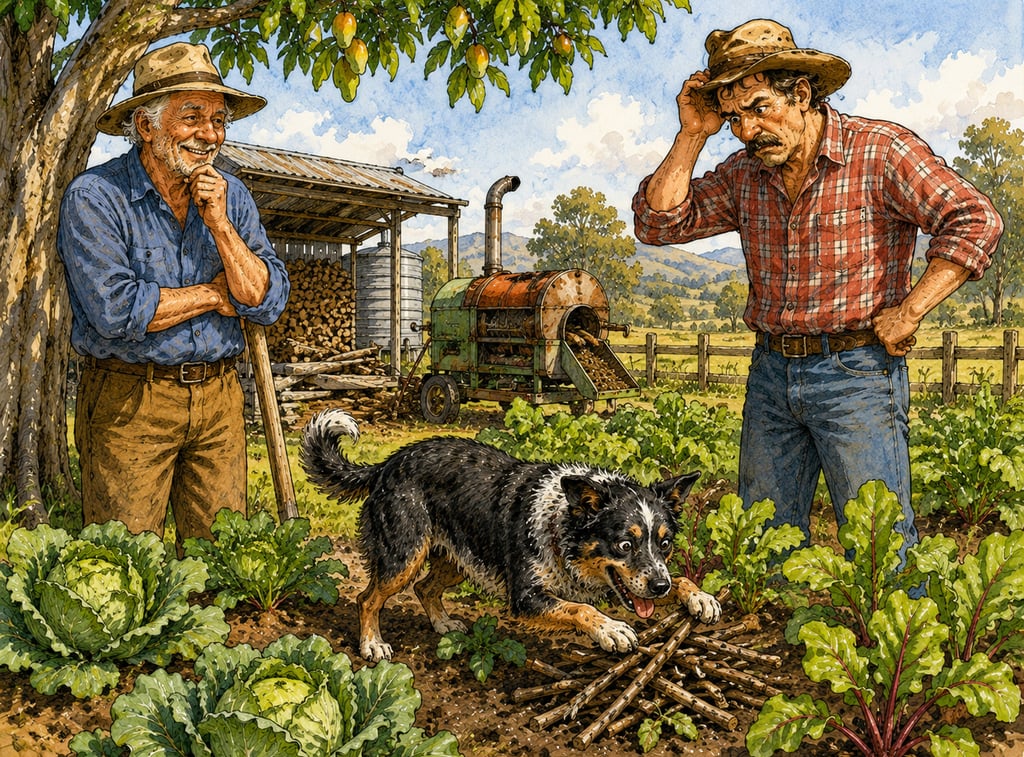
Dog, who had been asleep under the table, rolled onto his other side and continued drying in the traditional manner.
Bill looked down at him.
“Dog seems committed to the existing process.”
Tom ignored this.
“I’ll put the machine in the vegetable patch.”
Bill looked up.
“Why there?”
“Because dry firewood is important.”
“That’s why you want the machine. Why there?”
“It’ll create work.”
“Still the machine.”
“It’s innovative.”
“Still the machine.”
“I own the vegetable patch.”
Bill nodded slowly.
“Now that’s a reason for you.”
“Exactly.”
“Not much of a reason for the vegetables.”
Tom frowned.
“I’d rather put it beside the shed, but I don’t own that block.”
“So the vegetable patch is suitable because the suitable place belongs to someone else?”
“When you put it like that, it sounds silly.”
Dog got up, walked to the woodpile, selected a stick and carried it into the vegetable patch.
He dropped it between the cabbages, lay beside it and shut his eyes.
Tom stared at him.
“What’s he doing?”
“Drying firewood.”
“In the vegetable patch?”
“He owns the stick.”
“That doesn’t make it the right place.”
Bill smiled.
“No. It doesn’t.”
Tom looked at the machine plan, the dry woodpile and Dog’s lone stick among the cabbages.
Bill rolled the plan up.
“You’ve explained why dry firewood is useful.”
“Yes.”
“Why you like the machine.”
“Yes.”
“And why this patch is convenient for you.”
Tom hesitated.
“Yes.”
Bill nodded toward the woodpile.
“But you still haven’t explained why we need to change anything—or why that machine belongs in the vegetable patch.”
Dog opened one eye.
The stick was still not noticeably drier.
BYVQ Operations - Council Presentation
(15/07/2026)
(from a transcription of the audio presentation here)
Why Glan Devon
Rusty Mark’s explanation was:
“One is, right now, the South Burnett region is getting the benefit of the biosolids coming out here... We don’t want the South Burnett to lose that benefit... By building it here, we retain the benefit for the South Burnett.
The other thing is, is we actually give the South Burnett a locally sourced fertilizer supply, rather than relying entirely on overseas produced and manufactured mineral fertilizer.”
He also said:
“It is better to do it closer to the source, but right now we don’t have an option to do that.”
Taken together, these statements do not adequately explain why a waste-processing and thermal treatment facility should be located on this particular Rural-zoned block at Glan Devon rather than on appropriately zoned industrial land.
They explain why the applicant wants the South Burnett to retain access to the agricultural benefits of biosolids. That is a regional-benefit argument. It is not a site-selection argument.
There is also an obvious weakness in the claim that the South Burnett might otherwise “lose” that benefit. By the applicant’s own account, biosolids are already being transported into the region and applied directly to farmland. Under the do-nothing case, that practice would continue unless some separate change occurred.
So the proposal does not appear necessary merely to preserve an existing benefit. It seeks to change the form in which that benefit is delivered—from wet biosolids applied directly to land, to a processed and blended fertiliser product. That may be the applicant’s preferred business model, but it is not the same as showing that the region would lose access to biosolids without the Glan Devon facility.
The statement that processing closer to the source would be better is also important. It amounts to a tacit acknowledgement that Glan Devon is not being advanced as the ideal operational location. Rather, it appears to be the location presently available to the applicant because a preferable option closer to the source is not available.
That may explain the applicant’s business decision, but it does not answer the planning question.
The Planning Scheme does not ask whether the applicant already owns the land, whether another site is difficult to obtain, or whether the project would suit the applicant’s current commercial circumstances. It asks whether the proposed use is appropriate on this land, in this zone and in this setting.
The unanswered questions therefore remain:
Why a Rural-zoned site rather than industrial land?
What alternative sites were considered?
Why is Glan Devon preferable in terms of land-use compatibility, transport, services and surrounding uses?
What evidence is there that the South Burnett would lose the existing benefit of biosolids under the do-nothing case?
Why should the absence of a better commercial option justify this particular planning outcome?
The presentation therefore answers “Why does the applicant want to proceed here now?” It does not adequately answer “Why is this Rural-zoned site at Glan Devon the appropriate planning location?”
© 2026. All rights reserved.