The only change
What happens when an existing business wants to build a new factory and tells Council there's only one small change?
Scott Dunham
7/25/20269 min read
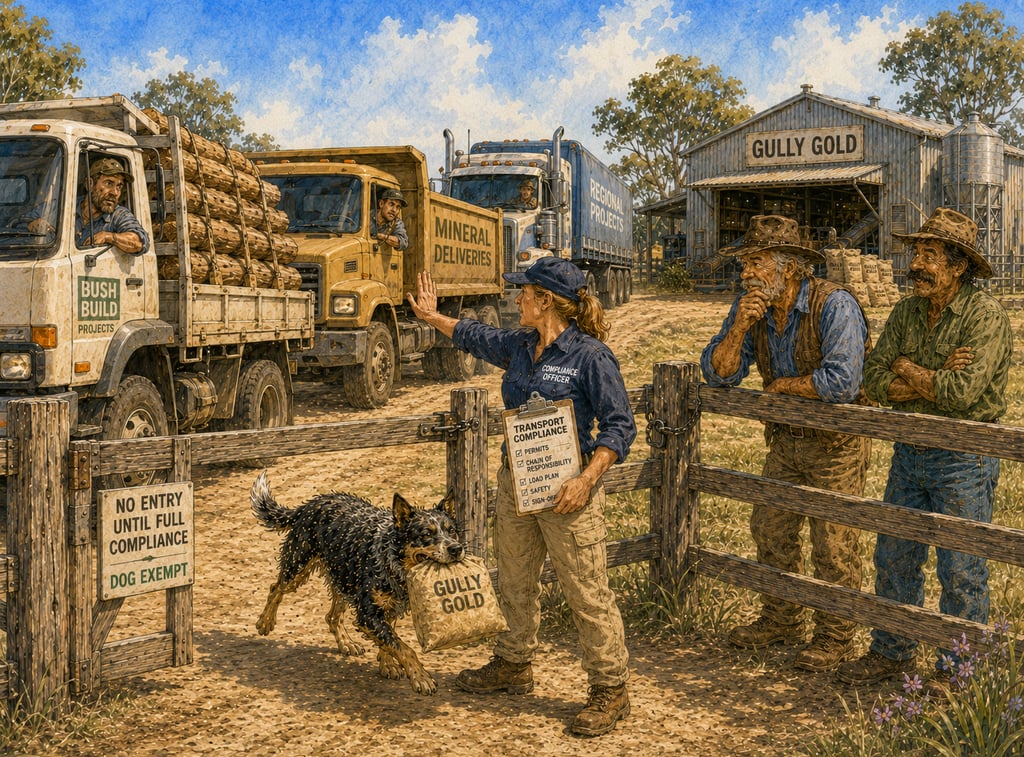
Bill had decided to build a soil-improvement factory on his back paddock.
“It’s a simple operation,” he told Tom. “We bring in wet fruit pulp from the cannery, dry it using waste timber, mix in a few minerals and sell it back to farmers.”
Tom looked across the paddock.
At present it contained three cows, an old water tank and Dog, who was trying to bury a bone in ground too hard to accept it.
“And you’re putting the factory there?”
“I own the paddock.”
Tom admitted this was one of Bill’s stronger planning arguments.
The cannery already sent four trucks of wet fruit pulp along the highway each day. At present they continued another sixty kilometres to a composting yard.
Under Bill’s proposal, they would turn left at his road and unload at the new factory.
At the Council meeting, one councillor asked about traffic.
“There’s very little change,” Bill explained. “Those four trucks already use the highway. Once the factory is built, they’ll simply stop and turn left at our road.”
“And that’s the only change?” the councillor asked.
“That’s the only change,” Bill said.
Tom, sitting behind him, raised one eyebrow.
Dog, sitting beside Tom, raised both ears.
Council approved the factory.
Because councillors liked clear conditions, they wrote Bill’s explanation into the approval:
The development is limited to the four existing fruit-pulp trucks turning left into the property. No other project-related vehicle movements are permitted.
Bill was delighted.
“Approved,” he said, showing the decision notice to Tom. “Exactly as I explained it.”
Tom read the condition twice.
“Yes,” he said. “Exactly.”
Six months later, the factory was complete.
It had a receiving shed, a dryer, a furnace, a mixer, a bagging line and a large sign that read:
GULLY GOLD
TURNING WASTE INTO VALUE
Dog had added value to the bottom corner of the sign by lifting his leg against it.
On Monday morning, Bill and Tom stood beside the gate.
At eight o’clock, the first fruit-pulp truck came down the highway, indicated and turned left.
Then another arrived.
By eleven o’clock, all four trucks had turned left and unloaded.
Bill looked at the wet pulp piled inside the shed.
“There you are,” he said. “Exactly as promised.”
“What happens now?” Tom asked.
“We dry it.”
Bill pressed the start button.
A warning light appeared.
NO FURNACE FUEL
Bill pressed the button again.
The warning remained.
“You need the waste timber,” Tom said.
“I know.”
“How does it get here?”
“On a truck.”
They both looked towards the gate.
Bill rang the timber recycler.
An hour later, a truck loaded with broken pallets arrived at the intersection.
A Council compliance officer held up her hand.
“You can’t bring that in.”
“It’s the fuel for the dryer,” Bill explained.
“It isn’t one of the four fruit-pulp trucks.”
“No, but the factory needs fuel.”
The officer consulted the condition.
“The approval permits the four existing trucks to turn left. No other project-related vehicle movements are permitted.”
Bill read the condition over her shoulder.
The timber truck continued along the highway.
For the rest of the morning, Bill collected fallen branches from beside the road while Dog carried them into the shed.
By lunchtime they had accumulated seventeen kilograms of fuel, two fence posts and part of an old chair.
The chair had not been waste when they started.
Bill lit the furnace.
It ran for nine minutes.
“That proves the dryer works,” he said.
“It proves the chair was flammable,” said Tom.
The four fruit-pulp trucks returned on Tuesday.
Then again on Wednesday.
By Thursday, wet pulp filled most of the receiving shed.
Dog had supplied enough sticks to dry half a wheelbarrow load.
Bill tipped the dry material into the mixer.
“Now we add the lime and mineral nutrients.”
“How do they get here?” Tom asked.
Bill stopped.
A mineral truck arrived later that morning.
The compliance officer stopped it at the gate.
“It’s part of the product,” Bill explained.
“It’s also another truck.”
“But we can’t make soil conditioner without it.”
The officer nodded sympathetically.
“I understand. But it isn’t one of the four trucks.”
The mineral truck drove away.
Bill went into town and bought several bags of garden lime.
He parked beside the highway, and he and Tom carried them towards the factory.
Dog helped by biting through the bottom of one bag and dragging it backwards along the road.
By the time they reached the shed, a white trail of lime ran from the gate to the mixer.
Dog was white from nose to tail.
“At least we can find him in the dark,” Tom said.
After another week, Bill produced the first batch of Gully Gold.
There were six bags.
Each carried a picture of healthy pasture, a sunset and an earthworm giving a thumbs-up.
“Now we sell it,” Bill said.
“To whom?”
“Farmers.”
“How do they collect it?”
“They drive in.”
Bill looked towards the gate.
The first customer arrived on Saturday morning.
The compliance officer stopped his ute.
“I’ve come to buy soil conditioner,” the farmer said.
“That makes the trip project-related.”
“I was already on the highway.”
“Were you going to turn left?”
“No.”
“Then turning left would be a change.”
The farmer continued into town and bought fertiliser there.
Bill tried loading the bags into his own ute.
The officer stopped him as he approached the gate.
“It’s all right,” Bill said. “I’m leaving, not arriving.”
“It’s still a project-related vehicle movement.”
Bill reversed back into the shed.
The six bags remained beside the mixer.
On Monday morning, one of the four pulp trucks broke down inside the entrance.
Bill called a mechanic.
The mechanic’s van was stopped at the gate.
He called a tow truck.
The tow truck was stopped as well.
Bill and Tom tried pushing the broken truck, but it was full of wet fruit pulp and weighed twenty tonnes.
Dog helped by barking at the rear wheel.
The truck did not move, but Dog appeared satisfied with his contribution.
Because the broken truck blocked the entrance, the other three approved trucks could not enter.
For the first time since the factory opened, no fruit pulp arrived.
Bill regarded this as progress.
“We’ve reduced the traffic,” he said.
Inside the shed, several hundred tonnes of wet pulp were beginning to ferment.
The dryer was cold.
The mixer was nearly empty.
The finished product could not leave.
The mechanic could not enter.
The broken truck could not be removed.
Dog emerged from the shed carrying one of the six finished bags in his teeth.
He dragged it beneath the fence and into the neighbouring paddock.
A cow tore the bag open and began eating Gully Gold.
Bill stood up.
“Dog’s made a delivery.”
Tom looked across the fence.
“That could be your distribution system.”
“How many bags can he carry?”
“One at a time.”
“We’re planning to make twenty thousand tonnes a year.”
Dog returned for another bag.
By sunset he had delivered four.
He had buried one and eaten part of the other.
Bill and Tom sat beneath the Gully Gold sign.
“I don’t understand it,” Bill said. “Council approved the factory.”
“No,” said Tom. “Council approved four trucks turning left.”
“But the factory needs fuel, minerals, maintenance and customers.”
“Yes.”
“And the product has to leave.”
“Yes.”
Bill looked at the silent dryer, the blocked gate and Dog digging up the bag he had buried half an hour earlier.
“I thought the four trucks were the traffic change.”
“They were one traffic change.”
Dog tore the bag open.
A gust of wind lifted the Gully Gold and spread it across Bill, Tom and the Council approval.
Bill wiped soil conditioner from his face.
“Well,” he said, “at least the factory is operating exactly as approved.”
Tom brushed the powder from his hat.
“Yes.”
Dog rolled in the remainder.
Four trucks had turned left.
And that was the only change.
What Bill Learned
Bill’s mistake was not that he forgot trucks.
His mistake was treating one reassuring statement as though it described the whole operation.
In the real presentation to Council, the claim was that four existing biosolids trucks would simply turn left at Mondure Crossing Road and that this was “the only change”. That was reassuring but it omitted the other traffic required by the operation. It omitted the trucks carrying the non-recyclable waste for fuel, the trucks delivering the mineral fertiliser for blending, the trucks carrying the product to market and the trucks removing the residues left from the process.
That is why Bill’s factory becomes absurd when Council accepts his words exactly. Four trucks are allowed to turn left. Everything else needed to operate the factory becomes an unauthorised change.
The fuel cannot arrive.
The minerals cannot arrive.
The finished product cannot leave.
The mechanic cannot enter.
Only Dog can keep the business moving, because nobody thought to condition the dog.
The joke works because planning approvals are not meant to operate on the general flavour of what an applicant intended to say. They operate through plans, limits and enforceable conditions.
A promise is not a condition
Applicants make many reassuring statements during the approval process:
traffic will barely change;
odour will be contained;
the plant will be almost unnoticeable;
feedstocks will be carefully selected;
products will be sold locally;
equipment will be properly maintained;
abnormal operations will be managed;
impacts will remain within acceptable limits.
Those statements may be honestly made. But honesty is not the same as enforceability.
A promise describes what the applicant presently expects or intends to do. A condition defines what the approved development is legally permitted or required to do.
That distinction matters because projects change.
Business plans change. Suppliers change. Feedstocks change. equipment is replaced. Production increases. Markets shift. Contractors adopt different work practices. A plant that begins as a small trial may grow towards the full capacity authorised by its approval.
Council cannot safely rely on the expectation that the project will continue to operate in the manner described at one meeting. It must decide what operation is actually being authorised and whether that operation remains acceptable across the range of activities the approval permits.
That permitted range is the operating envelope.
For Bill’s factory, the operating envelope would include matters such as:
how much wet fruit pulp could be accepted;
what fuels could be burnt;
what minerals could be added;
how much product could be manufactured;
how many trucks and other vehicles could enter and leave;
when the plant could operate;
how much material could be stored;
what happened during startup, shutdown, maintenance and breakdowns.
For a real industrial facility, the list is longer. It may include feedstock sources and composition, contaminant limits, throughput, thermal input, equipment configuration, pollution-control performance, stack conditions, operating hours, storage limits, waste streams and transport movements.
The assessment should examine that envelope.
The conditions should then keep the actual operation inside the part of the envelope shown to be acceptable.
That is the connection between evidence, promises and conditions:
The evidence establishes which operation is acceptable.
The conditions confine the project to that operation.
The promises have value only where they are translated into those conditions.
If the assessment assumes four trucks but the approval permits ten, the assessment and approval do not describe the same operation.
If the assessment assumes one type of fuel but the approval allows a broader range, they do not describe the same operation.
If the model assumes particular throughput, emissions and pollution controls but the final plant may operate differently, the model has assessed one envelope while the approval authorises another.
The conditionability test
Bill’s predicament provides a simple test for any reassuring claim:
Could Council write that statement directly into an enforceable condition and still have a functioning project?
If the answer is yes, the applicant should have little difficulty accepting the condition.
If the answer is no, then the statement was not a complete description of the operation.
Applying that test to the truck claim produces two possibilities.
Council could condition the project on only four existing trucks turning left. The statement would then become enforceable—but, like Bill’s factory, the plant could not undertake the other movements required to operate.
Alternatively, Council could approve the additional deliveries, outgoing product, residue removal, employees, contractors and service vehicles needed by the facility. The plant could operate—but the four trucks would plainly not be “the only change”.
The applicant cannot rely on the narrow statement for reassurance while relying on a broader operating envelope for approval.
Conditions cannot repair a missing assessment
There is a further lesson.
Conditions are useful when the acceptable operating envelope has already been identified. They can impose throughput limits, restrict inputs, control hours, require monitoring and prevent operation outside specified parameters.
But conditions cannot substitute for first understanding the project.
Council should not approve a broadly described facility and assume that conditions can be written later to manage whatever the final design requires. That reverses the proper sequence.
The sequence should be:
identify the operation that may reasonably occur;
assess its likely impacts and uncertainties;
determine which part of that operating envelope is acceptable;
authorise only that part through clear and enforceable conditions.
Otherwise, Council may find itself in one of two positions.
It may write conditions so literally that the project cannot function.
Or it may write conditions broadly enough for the project to function, but broader than the operation used to reassure the community and support the assessment.
Bill learned that “only four trucks turn left” was not a small factual detail. It was a claimed boundary around the project.
Once Council treated it as a real boundary, the factory stopped at the gate.
Dog, fortunately, was outside the operating envelope.
© 2026. All rights reserved.