The Whole Operation Is Not the Sum of Its Parts
Why looking at the pieces doesn’t mean you understand the whole picture.
Scott Dunham
6/19/20263 min read


The Whole Operation Is Not the Sum of Its Parts
One of the most common mistakes in evaluating complex industrial projects is to assess each component in isolation and then assume that if every component is technically feasible, the overall project must also be feasible.
Unfortunately, that is not how complex systems work.
A modern industrial facility is not simply the sum of its parts. It is a system of interconnected processes, constraints, costs, risks and performance requirements. Changes made in one area inevitably affect others, sometimes in unexpected and highly non-linear ways.
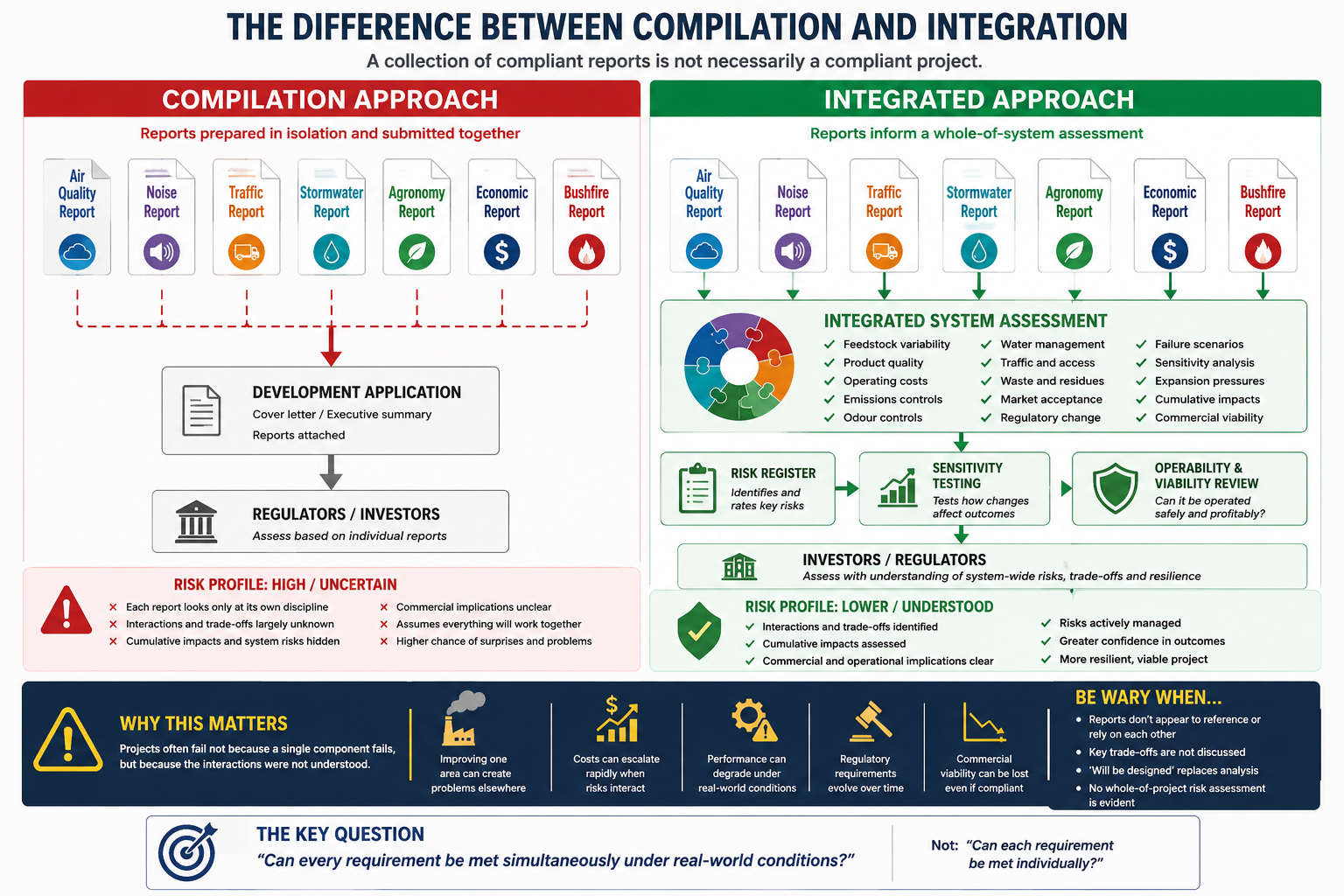
This distinction is particularly important when reviewing development applications supported by numerous specialist reports. Environmental consultants assess environmental impacts. Traffic engineers assess traffic. Air quality specialists assess emissions. Agronomists assess agricultural impacts. Acoustic consultants assess noise. Hydrologists assess water management.
Each discipline answers a specific question:
“Can this aspect of the project comply with the relevant requirements?”
What is often missing is the broader question:
“Can all of these requirements be met simultaneously while maintaining a safe, reliable and commercially viable operation?”
These are not the same question.
The Problem of Isolated Assessments
Specialist reports are generally designed to demonstrate compliance within a specific field of expertise.
An air quality report may conclude that emissions can be controlled through additional filtration or abatement systems.
An odour assessment may conclude that odour can be managed through building enclosure, negative pressure systems and biofilters.
A stormwater assessment may conclude that contaminated runoff can be contained through detention ponds, leachate management systems and monitoring programs.
Viewed individually, each conclusion may be reasonable.
However, each solution comes with consequences.
Additional filtration increases capital cost, operating cost, maintenance requirements and energy consumption.
Negative pressure systems increase electricity demand and maintenance complexity.
More stringent waste acceptance criteria may reduce contamination risk but also reduce feedstock availability and increase operating costs.
Larger leachate storage facilities may improve environmental protection but increase construction costs and land requirements.
The reports rarely examine these interactions.
Instead, each report tends to assume that whatever controls are necessary will simply be implemented.
Compliance Does Not Equal Viability
A facility may be technically capable of meeting environmental standards while simultaneously becoming economically unviable.
This is not unusual in industrial projects.
For example, if emissions exceed expectations during commissioning, the operator may have several options:
* Install additional emission control equipment.
* Reduce throughput.
* Restrict feedstock acceptance.
* Increase monitoring and testing.
* Upgrade operating procedures.
Each option may improve compliance.
Each option may also increase costs or reduce revenue.
The environmental problem may be solved while creating a commercial problem.
Likewise, tighter waste acceptance criteria may improve product quality and reduce environmental risk, but they may also reduce available feedstock and increase procurement costs.
Again, one risk decreases while another increases.
The project remains compliant but may become less robust.
Risk Is Not Additive
Another common misconception is that risks simply add together.
In reality, risks often interact and amplify each other.
A modest increase in feedstock variability may lead to:
* Increased emissions variability.
* Reduced product consistency.
* Increased maintenance requirements.
* Reduced throughput.
* Higher testing costs.
Each effect then creates secondary consequences elsewhere in the system.
The resulting impact may be substantially larger than the original change.
This is why industrial projects are often described as operating within a “window” or “envelope” of acceptable performance.
Outside that envelope, problems can escalate rapidly.
The relationship is frequently non-linear.
Small changes can have disproportionately large consequences.
The Missing System-Level Assessment
The most important question for any complex project is not whether individual technical issues can be managed.
It is whether the entire system remains robust when multiple constraints operate simultaneously.
For example:
* Can emissions remain compliant while processing variable feedstocks?
* Can odour remain controlled during wet weather events?
* Can water management systems cope with extreme rainfall while maintaining operational continuity?
* Can contaminant limits be met while maintaining product quality and market acceptance?
* Can all of these requirements be achieved without making the operation economically unsustainable?
These are system-level questions.
They sit above the individual disciplines.
Yet they are often the questions that determine whether a project ultimately succeeds or fails.
Lessons from Other Industries
Mining provides a useful example.
A mine is not considered viable simply because:
* A pit can be designed.
* Ore can be processed.
* Tailings can be stored.
* Roads can be built.
* Environmental approvals can be obtained.
All of these components must function together within the same economic and operational framework.
A change in one area can affect all the others.
The same principle applies to waste processing facilities, energy projects, manufacturing plants and infrastructure developments.
Success depends not only on whether each individual issue can be managed, but whether the combined management requirements remain practical, affordable and sustainable over the life of the project.
Looking Beyond Compliance
Regulatory compliance is essential.
However, compliance alone is not sufficient to demonstrate project robustness.
A project should also demonstrate:
* Operational resilience.
* Commercial resilience.
* Sensitivity to changing conditions.
* Ability to manage feedstock variability.
* Ability to manage market variability.
* Ability to absorb increased regulatory requirements.
* Ability to respond to unforeseen events.
In other words, the assessment should consider the whole system, not merely the individual components.
The key question is not whether each specialist report reaches a positive conclusion.
The key question is whether all of those positive conclusions can coexist within the same operating business.
That is where the true risks often reside.
© 2026. All rights reserved.