The young bloke and the broom
Promises and reassurances are not the same as a defined operating envelope backed by measurable and enforceable conditions.
Scott Dunham
7/20/20267 min read
Bill was sitting under the mango tree when Tom came through the gate carrying a development application.
Dog was beneath the table, watching a biscuit on Bill’s saucer with the concentration of a senior compliance officer.
“How’s the reading?” Bill asked.
“Plenty of reassuring statements.”
“That sounds reassuring.”
“That’s what worries me.”
Bill pushed the spare chair out with his boot.
“What’s the problem?”
“I’m trying to work out the operating envelope.”
“And have they included one?”
“They’ve included several hundred pages.”
“Different unit of measurement.”
Tom sat down.
“I first learned about operating envelopes before I became an engineer.”
Bill looked surprised.
“I thought engineers were born knowing everything.”
“We’re born sounding as though we do. The paperwork comes later.”
Tom put the folder on the table.
“While I was working my way through university, I had a contract cleaning a clothing factory.”
“Technical work?”
“Highly. I swept fabric scraps from around the sewing machines and cutting tables, emptied the bins, cleaned the toilets and generally kept the place tidy.”
“What did the contract say?”
“Clean the factory.”
“That specific?”
“More or less.”
Tom shifted in his chair.
“For a while, my interpretation of ‘clean the toilet’ involved putting disinfectant in the bowl and giving it a swish with the brush.”
“What about the seat?”
“Optional.”
“Outside of the bowl?”
“Outside the operating envelope.”
Bill took a slow sip of tea.
“Whose envelope?”
“Mine, as it turned out. The owner’s customers had a broader interpretation.”
“How did the monitoring system detect the difference?”
“Someone complained. The owner rang my father.”
Bill looked at Tom.
“Strong regulatory response.”
“Immediate escalation to the parent authority.”
Dog glanced from one man to the biscuit and concluded that enforcement remained unlikely.
“The owner wasn’t unreasonable,” Tom said. “He thought ‘clean the toilet’ had an obvious meaning. I also thought it had an obvious meaning. Unfortunately, they were different meanings.”
“So the problem wasn’t whether you promised to clean it.”
“No. The problem was that the promised outcome had no defined method, frequency or acceptance standard. Until someone complained, my interpretation was the system.”
Bill nodded.
“And a fairly economical system it was.”
“Very low operating cost.”
Tom reached for the teapot.
“Then there was the burglar alarm.”
Dog’s ears came up.
“One night I unlocked the factory and the alarm went off. I entered the code. Nothing happened. Tried again. Still screaming.”
“So you left?”
“No. I had work to do.”
“Called the owner?”
“Possibly later.”
“Called the alarm company?”
“It was before mobile phones were common.”
“That explains everything except why you stayed inside a factory with the burglar alarm going.”
Tom shrugged.
“After a while it became background noise. I kept sweeping.”
Bill picked up the broom leaning against the tree.
Dog immediately moved behind the ute.
“Better risk assessment than yours,” Bill observed.
“Considerably.”
“What happened?”
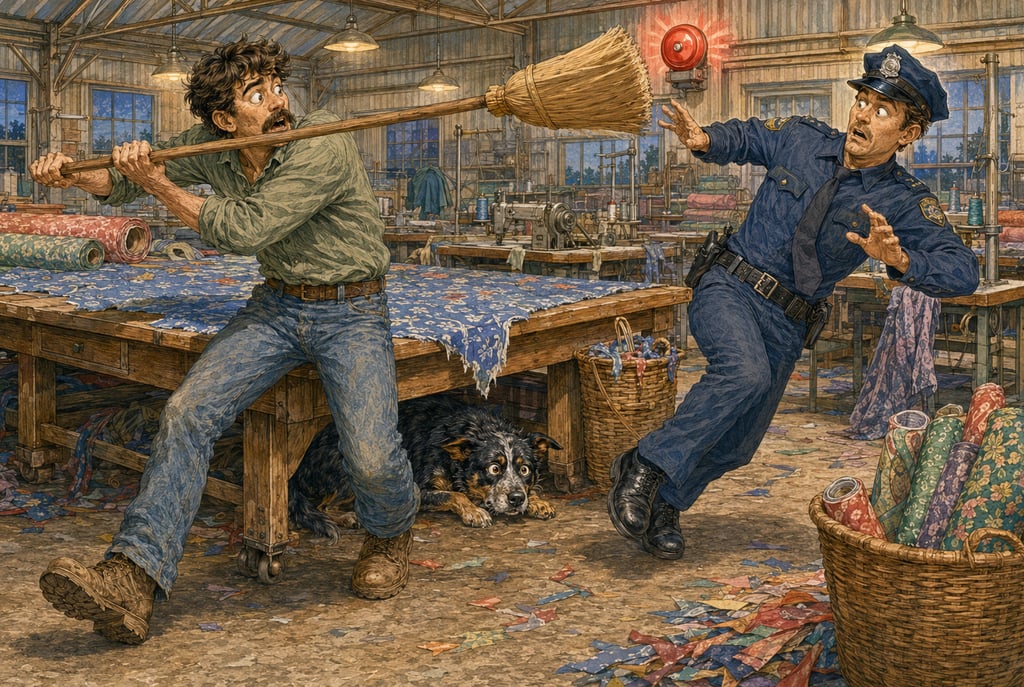
“I was sweeping fabric scraps from under a cutting table when someone tapped me on the shoulder.”
“And?”
“I swung the broom around at head height.”
Bill lowered the broom.
“Who was it?”
“Police officer investigating the alarm.”
“Good outcome?”
“He was quick on his feet.”
Dog remained behind the ute. He had formed the view that a successful near miss did not justify restarting the demonstration.
“That,” Tom said, “was abnormal operation.”
“The alarm was abnormal.”
“Yes. But alarms do occur. The trouble was that nobody had clearly said when work stopped, who was called, whether the cleaner stayed outside or what had to happen before work resumed.
“So you improvised.”
“I normalised the alarm and kept production going.”
“Cleaning.”
“Cleaning production.”
Bill nodded gravely.
“Important distinction.”
“The procedure was basically ‘Tom will use his judgment’.”
“And Tom’s judgment said keep sweeping until contacted by police.”
“It worked on that occasion.”
“So did the policeman’s footwork.”
Tom poured the tea.
“The factory also had a Christmas party every year.”
“I’m beginning to see the danger.”
“My normal cleaning round handled fabric scraps, bins and toilets. The Christmas party produced bottles, food, streamers, overflowing bins and things underneath tables that nobody wanted to identify.”
“Unexpected event?”
“Happened at Christmas.”
“Every year?”
“Reliably.”
“So exceptionally predictable.”
“Yes, but it wasn’t part of the normal round. The cleanup tended to remain where it was for several weeks and then became urgent just before everyone returned from holidays.”
“A once-a-year emergency.”
“Scheduled annually.”
“But treated as abnormal.”
“Exactly.”
Bill looked towards Dog, who had emerged from behind the ute and resumed monitoring the biscuit.
“And the fabric scraps?”
“They were the mass balance. Rolls of fabric came in. Clothes went out. Offcuts and dust accumulated around the machines until someone removed them.”
“Someone being the control system.”
“Me.”
“The young bloke who didn’t wipe the toilet, worked through burglar alarms and scheduled the Christmas cleanup for late January.”
“I improved over time.”
“Through formal process review?”
“Dad had a word.”
Bill picked up Tom’s folder.
“So what does your cleaning career have to do with this?”
“It taught me that a desired outcome isn’t an operating envelope. ‘Keep the factory clean’ sounded perfectly clear until a real operator had to decide what counted as clean, what happened during an alarm and whether an annual event belonged in normal planning.”
“And an industrial application?”
“Same principle, bigger consequences. What can come in? How much? How variable can it be? What equipment and controls have to work? Where does everything go? How is performance measured? And what happens when the operation is outside specification?”
“Not just what it’s expected to do on an ordinary day.”
“No. Ordinary days are the easy ones. The envelope has to include foreseeable variation, startup, shutdown, failed equipment, rejected loads and unusual events that everyone knows will eventually occur.”
Bill turned a few pages.
“What if the application says the operator intends to keep everything contained and running properly?”
“I intended to clean the factory.”
“Fair point.”
“Intentions matter. But they’re not controls, measurements or shutdown rules. If the approval leaves the important boundaries vague, it relies on the operator continuing to interpret the promise sensibly.”
Bill looked at Tom.
“Which operator?”
“Whoever happens to be holding the broom.”
At that moment Dog rose, took the biscuit neatly from Bill’s saucer and carried it beneath the ute.
Bill watched him go.
“Clear breach.”
“What’s the enforcement procedure?”
Bill considered the empty saucer.
“Apparently we wait for someone to complain and ring his father.”
⸻⸻⸻⸻⸻⸻⸻⸻⸻⸻⸻⸻⸻⸻⸻⸻⸻⸻⸻
What Tom learned as a lad
Tom’s cleaning contract contained a perfectly sensible aspiration: keep the factory clean. The problem was that the aspiration left the young bloke holding the broom to decide what “clean” meant.
Most nights that worked well enough. Trouble appeared around the edges. Did cleaning the toilet mean the whole toilet or only the part containing disinfectant? Did a screaming burglar alarm mean stop work and leave, or carry on sweeping? Was the Christmas party cleanup an exceptional event, even though it occurred every Christmas?
Those were not questions about Tom’s honesty. He intended to do the job. They were questions about how much the system depended on his interpretation and judgment.
That is what an operating envelope is meant to fix. It converts a desired outcome into defined boundaries: what may happen, how much, under what conditions, how performance will be measured and what must happen when the operation moves outside those conditions.
That lesson matters directly to the proposed Glan Devon development.
Public reassurances describe the operation people hope will be built: modest throughput, contained odour, limited traffic, reusable water and a furnace that converts unwanted material into useful heat. Those may be sincere intentions. But unless they are carried into the application, approved plans, conditions and Environmental Authority, they do not necessarily define what may ultimately be built and operated.
Before approval, the permitted scale needs to be unambiguous. If the plant is expected to process about 40,000 tonnes rather than having a pathway to 120,000 tonnes, the approval should say so. The permitted biosolids, combustible materials and other inputs must be defined, together with acceptance and rejection criteria that account for their real variability.
The incinerator is central to that assessment. Its feed, loading range, combustion conditions, cooling pathway and air-pollution-control system determine what goes up the stack and what remains in ash and pollution-control residues. A promise that suitable controls will be designed later is not the same as demonstrating that a defined system can control emissions across the range of materials and operating states the approval would permit.
The application also needs a whole-of-operation mass balance. Biosolids, combustible waste, mineral additives, air and water enter the facility. Product, stack emissions, vapour or condensate, ash, treatment residues, rejected loads and stored inventory leave or accumulate. Calling one stream a useful product does not account for the others. Everything still goes somewhere.
Assessment at a nominal or average condition is not enough if the approval permits a wider and more variable operation. Feedstocks change. Moisture and contaminant concentrations vary. Filters age. Instruments drift. Startup, shutdown, equipment failure and extended storage are not imaginary events merely because they sit outside normal operation.
The approval framework therefore needs credible measurements and predetermined responses. What happens when negative pressure is lost, a load fails acceptance criteria, the dryer stops, condensate is out of specification, a product batch fails testing or a stack result exceeds its limit? The answer should already be defined; reject, quarantine, reprocess, shut down, notify or dispose lawfully—not “the operator will decide at the time”.
This does not assume that future operators will behave badly. Tom’s youthful cleaning career demonstrates the opposite point: even well-intentioned people interpret vague instructions differently, adapt processes, normalise alarms and find practical workarounds.
The central question for the Glan Devon DA is therefore straightforward: does the application define the operation whose impacts have actually been assessed, and will the approval keep the real operation within those assessed boundaries?
If not, the missing detail is not merely paperwork to be settled after approval. It is part of the development that decision-makers and the community are being asked to accept.
Tom eventually learned to wipe the outside of the toilet bowl. A sound approval should not depend on an industrial operator learning the equivalent lesson after the plant starts.
© 2026. All rights reserved.