Tom's Performance-based fence
Unitywater and BYV have both lodged biosolids-related development applications—but their system architecture and business logic are very different.
Scott Dunham
7/27/20264 min read
Tom’s Performance-Based Fence
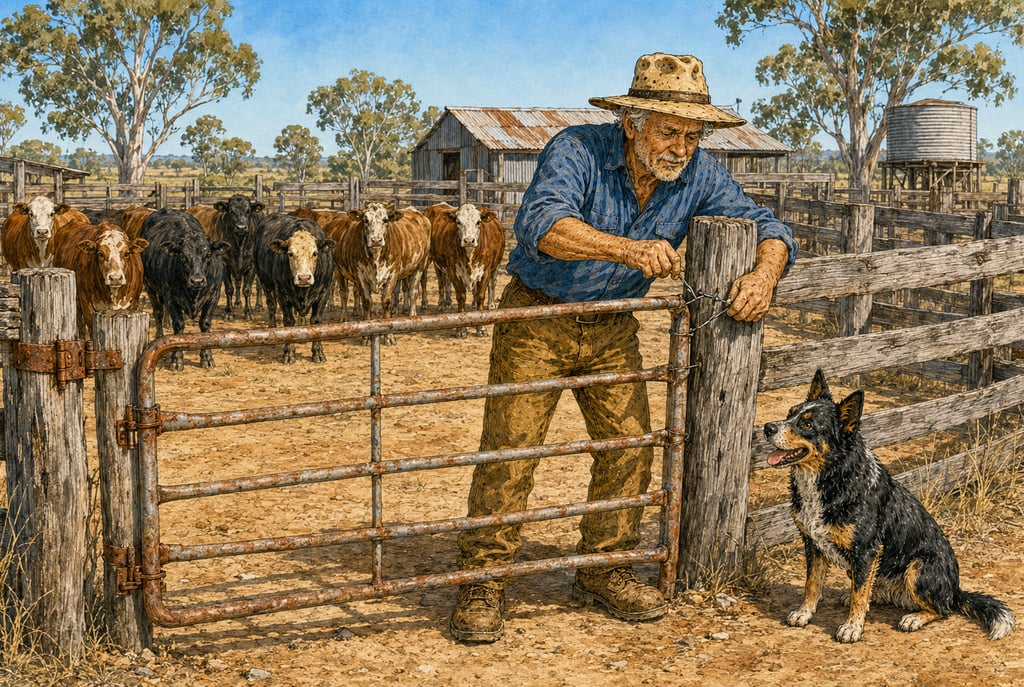
Bill had twelve quiet cattle, an old set of yards and a gate that could only be shut with fencing wire and a personal understanding of metaphysics and quantum foundations.
So he replaced the lot.
He built the new yards beside his shed, on his own land, using a standard design from a bloke in Toowoomba who had been building cattle yards since cattle first began objecting to them.
The manufacturer knew the size and number of Bill’s cattle. Bill knew where they came from because they were standing in his paddock. He knew how they would arrive because he would walk them through the eastern gate.
It was not an imaginative project.
It merely solved Bill’s problem.
Tom watched the yards go up and saw an opportunity.
Within a fortnight he announced the proposed South Burnett Multi-Species Livestock Reception, Improvement and Regional Value-Adding Facility.
“Catchy,” said Bill.
“It’ll take livestock from all over the district,” Tom explained. “Possibly beyond.”
“What sort?”
“Whatever the market supplies.”
“Cattle?”
“Potentially.”
“Sheep?”
“We don’t want to be prescriptive.”
“Pigs?”
“That would depend on future commercial arrangements.”
Dog, who had been listening beneath the ute, recognised the approach. It was the same one he used when asked what he had been rolling in.
Tom’s facility would occupy a paddock he had arranged to lease from a cousin. Animals would arrive from suppliers yet to be identified, using routes to be determined once the suppliers were known.
The yards would be designed once Tom established what animals would use them.
“What have you settled?” Bill asked.
“The outcome.”
“What’s that?”
“The animals stay inside.”
Tom erected a short demonstration fence beside the entrance. It consisted of three steel rails with generous gaps between them.
Dog walked through it.
“Dogs aren’t part of the present supply case,” Tom said.
Dog walked back through a different gap.
Tom lodged his application with Council.
The Council officer read it twice. The first time she assumed she had missed the drawings. The second time she discovered the drawings had missed the drawings.
She wrote to Tom.
Please identify the species, sizes and maximum number of animals to be accommodated.
Tom replied that a species-specific approval would unnecessarily restrict innovation and future supply opportunities. His preferred approach was a performance-based framework focused on animal-retention outcomes.
The officer tried again.
Please provide the proposed fence design.
Tom replied that the final fencing system would be selected during detailed design to suit the animals received.
Please identify the animals so Council can assess whether the fence will contain them.
Tom replied that the facility would only accept animals capable of being safely contained by the approved fence.
The officer sat quietly for a while.
Meanwhile, Dog walked through the demonstration fence again. Tom added a fourth rail.
Dog went underneath it.
Tom said ground-level performance would be addressed through an adaptive containment-management process.
Council asked about trucks, operating hours, noise, manure, water, loading arrangements and escaped animals.
Tom said each matter could be addressed by suitable approval conditions and a Livestock Acceptance and Containment Management Plan.
“Who writes the suitable conditions?” Bill asked.
“Council.”
“Who decides what fence is needed?”
“The final design team, subject to Council approval.”
“Who proves it works?”
“The monitoring program.”
“With what animals?”
“The animals we receive.”
“And what animals are they?”
“That,” said Tom, “is commercially sensitive and not yet known.”
Bill looked across at his cattle, which had never shown the slightest interest in commercial sensitivity.
Council engaged a livestock-yard engineer.
The engineer asked whether the facility would hold cattle.
Potentially.
Pigs?
Possibly.
Goats?
Not excluded.
Horses?
Not nominated.
Dogs?
The officer looked at Dog.
Dog was halfway through the fence.
The engineer explained that a fence suitable for quiet cattle might not contain goats, pigs or dogs. Different animals required different heights, panel spacing, gates, loading facilities, drainage and handling arrangements.
Council asked him to advise what conditions would cover every reasonably possible animal.
He submitted an estimate for further work.
It was the first firm number the project had produced.
While the questions went backwards and forwards, Bill finished his own yards. His cattle walked through the eastern gate, stood where expected and left by the same route.
Nothing escaped.
No management plan was required.
Eventually, Bill told Tom that his cattle would no longer be available.
“I handle them here now,” Bill said. “Cheaper and simpler.”
“That doesn’t affect the project,” Tom replied. “There are plenty of other animals.”
“Whose?”
“That depends on future contracts.”
“Coming from where?”
“That depends on whose animals they are.”
“Using which roads?”
“The appropriate ones.”
“And your application covers all that?”
“It covers a regional livestock facility.”
Bill considered this.
“No,” he said. “It covers your plan for my cattle. You just haven’t got my cattle anymore.”
Tom said the distinction was unnecessarily technical.
He strengthened the demonstration fence by adding wire mesh. Dog examined it, walked around the end and sat outside.
“The completed facility will have appropriate boundary controls,” Tom explained.
Bill nodded towards the open end.
“Will Council be designing those too?”
“Council will impose whatever conditions it considers necessary.”
“And if Council approves cattle but you end up with goats?”
“We’ll demonstrate equivalent performance.”
Dog returned around the other end.
“Seems equivalent,” said Bill.
Tom maintained that everyone was becoming distracted by minor design details instead of concentrating on the environmental outcome.
“The outcome is that nothing escapes,” he said.
Bill looked at Dog, sitting once again outside the proposed facility.
“That’s a fine outcome,” he said. “You’ve just left Council to invent the fence that achieves it.”
Tom explained that this was modern, flexible regulation.
Bill looked at the Council officer, the livestock engineer and the growing folder of unanswered questions.
“Flexible for whom?”
Dog scratched himself.
It was the only performance measure operating exactly as designed.
What Bill Learned
A performance-based approval can work, but the performance must belong to a defined system.
It is reasonable to require that no animal escape. It is not enough to promise that outcome while leaving the animals, fence, gates, operating limits and testing method to be decided later.
Conditions can hold a known operation inside an approved boundary. They cannot identify the operation, design its controls and demonstrate that those controls will work.
Tom kept the flexibility.
Council inherited the engineering problem.
And before anyone could police the boundary, somebody still had to build the bloody fence.
© 2026. All rights reserved.